The sorter: transfer vs. convergence
Information transfer — status, updates, announcements, FYIs — has a one-way shape: sender knows, receivers learn. Synchronous time adds nothing to the payload; it just forces simultaneous consumption at the speed of the slowest speaker. Convergence — resolving disagreement, negotiating trade-offs, building trust, creative collision — is interactive by nature: each utterance depends on the last, and latency kills it. The test for any calendar entry: does this produce agreement that didn’t exist before, or does it distribute facts that already exist? Facts go async. Agreement gets the meeting.
The sorting table, applied
Async by default: status updates and standup content (a thread with three prompts), project announcements (a doc with comments), most reviews (async comments, meeting only for contested threads), scheduling logistics (booking links, not negotiation calls), and recurring "sync" meetings whose last month produced zero decisions — those are transfer meetings wearing convergence costumes. Sync by right: decisions with live disagreement, kickoffs and postmortems (alignment + trust), anything emotionally loaded (feedback, conflict, bad news), true brainstorms (collision needs latency-free bounce), and first meetings with new people — trust formation is the one payload that genuinely doesn’t compress into text.
Converting a meeting to async without losing it
The failed conversion — "let’s just cancel the sync" — loses the deadline and the visibility, and the update quietly dies. The working conversion keeps both: same cadence, same deadline, different medium. The Wednesday sync becomes the Wednesday-noon thread with the same three prompts; a named owner pings gaps by 14:00; contested items (and only those) get a 15-minute call on demand. Critically, the calendar keeps a marker — a 15-minute "async window" event holding the deadline — because commitments that lose their calendar presence lose their existence within a month.
The hybrid patterns that outperform both
The strongest formats are sequenced, not chosen: async-then-sync (context and positions in the doc by Tuesday night; the meeting starts at the disagreement — this is how 60-minute meetings become 15s), and sync-then-async (a 10-minute kickoff call for ambiguous work, then async execution — repaying an hour of confused threads). The anti-pattern is the unsequenced both: a meeting and a thread and a doc, each partially duplicating the others, which is how "we communicate a lot" and "nobody knows anything" coexist.
Reading your own calendar with the sorter
Run last week through the test: for each meeting, transfer or convergence? Typical knowledge-work finding: 30–50% of recurring meeting time is transfer — which is the honest size of your async conversion opportunity. Convert the two worst offenders first (largest audience × least interaction), run the conversion pattern for four weeks, and let the recovered hours argue for the rest.
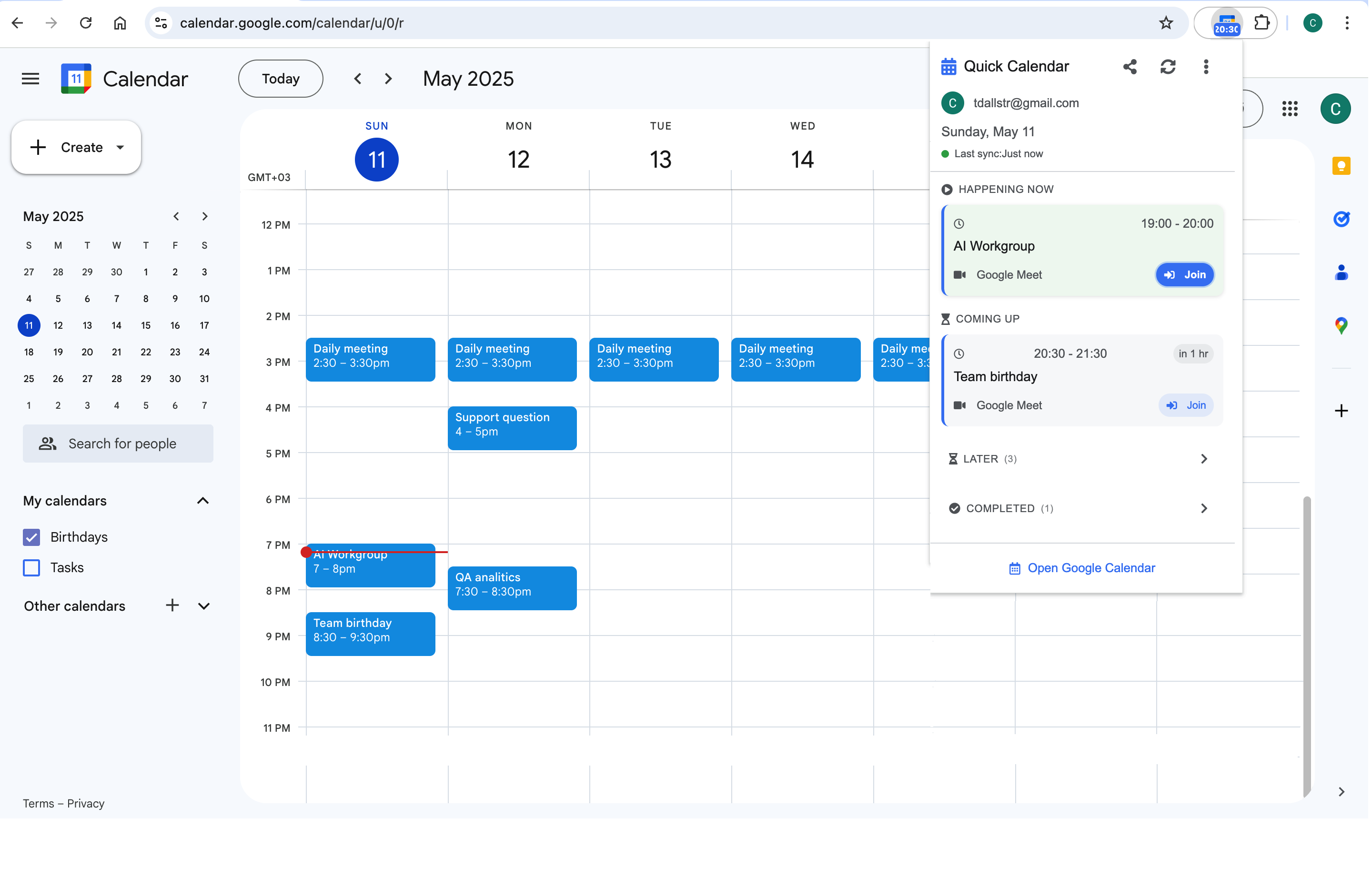
Async-heavy weeks change the calendar’s texture — fewer events, more deadlines-with-windows. The glanceable version of that day matters more, not less: a toolbar strip like Calendar Extension for Google Calendar™ keeps the async windows and the few remaining真 syncs in one view, so the medium switch doesn’t cost the schedule its visibility.
Frequently asked questions
The thread lacks what the meeting had: a deadline and consequences. Working async needs both — a named time ("answered by Wed noon"), an owner who chases gaps, and decisions that proceed without late input. Threads die when silence is free; meetings were never the only way to make it costly.
1:1s are convergence-and-trust vehicles — keep them sync. What converts is their transfer content: status belongs in a shared doc updated before the 1:1, so the live time spends itself on the real payload (blockers, growth, disagreement) instead of readouts.
The realistic end-state is a ratio shift, not zero: convergence needs don’t vanish, and forcing them async produces the worst artifact in remote work — the fifty-message thread that a 15-minute call would have settled. Aim for transfer→async, convergence→sync, and the meeting count finds its honest level.
Organizers own the format, but attendees hold conversion evidence: "the last four of these had no decisions — could we try the thread format?" is a legitimate, data-backed ask. Teams that let anyone propose conversions (with the owner deciding) converge faster than either top-down mandates or silent suffering.