What the calendar becomes when meetings aren’t the unit
A meeting-centric calendar tracks attendance; an async calendar tracks commitments: the decision thread closing Thursday noon, the review window before the release, your own focus blocks, and the few synchronous slots that survive scrutiny. The grid gets emptier and each entry gets heavier — which changes the hygiene requirements: on a sparse calendar, a stale entry is conspicuous, and honesty becomes cheaper to maintain than it ever was on a dense one.
The survivors: what stays synchronous
Async-first is a default, not a religion. Four meeting types survive on the calendar because their payload genuinely doesn’t compress: conflict resolution (latency poisons disagreement — a 25-minute call beats a 50-message thread every time), trust formation (first meetings, onboarding pairings, the periodic team social), high-ambiguity kickoffs (ten minutes of live Q&A saves a week of thread archaeology), and the cadence heartbeat — one short all-hands or team call at a fair rotating hour, because pure-async teams drift into being strangers with a shared repository.
Scheduling the async objects themselves
The core trick: async commitments get calendar presence without attendance. A decision thread gets a 15-minute "closes: pricing decision" event at its deadline — visible to all participants, blocking nobody. Review windows get all-day events on the team calendar. Your response-time obligations get batched into two daily "async processing" blocks (the async equivalent of meeting load — unscheduled, it metastasizes into all-day ambient checking). The calendar thus keeps its old superpower — making time-shaped commitments visible and collision-checked — with attendance subtracted.
The three async-specific failure modes
- Deadline invisibility: threads without calendar presence die quietly — "objections by Thursday" scrolls away in chat. The closes-event fixes it; no calendar object, no commitment.
- Ambient always-on: without meeting edges, work diffuses into every hour — async teams show worse after-hours creep than meeting-heavy ones unless edges are scheduled deliberately (hard start/stop anchors, the two processing blocks, fringe-hours focus).
- The consensus mirage: silence in a thread reads as agreement and isn’t. The scheduling fix is procedural: decision events name the quorum ("closes Thu; needs explicit 👍 from Dana, Alex, Sam") — the calendar entry carries the decision’s requirements, not just its deadline.
Running your personal calendar inside an async team
Individual practice shifts three ways. Focus placement inverts: with few meetings, your deepest block goes wherever your energy peaks — the async dividend is claiming it without negotiation. The processing blocks are sacred: two bounded windows (morning, mid-afternoon) where threads, reviews, and mentions get answered — outside them, notifications off; the SLA is "within a working day", not "within the hour". Weekly planning gets heavier: without standups pacing the week, the Friday reset and daily close carry the whole rhythm — async autonomy is planned autonomy or it is drift.
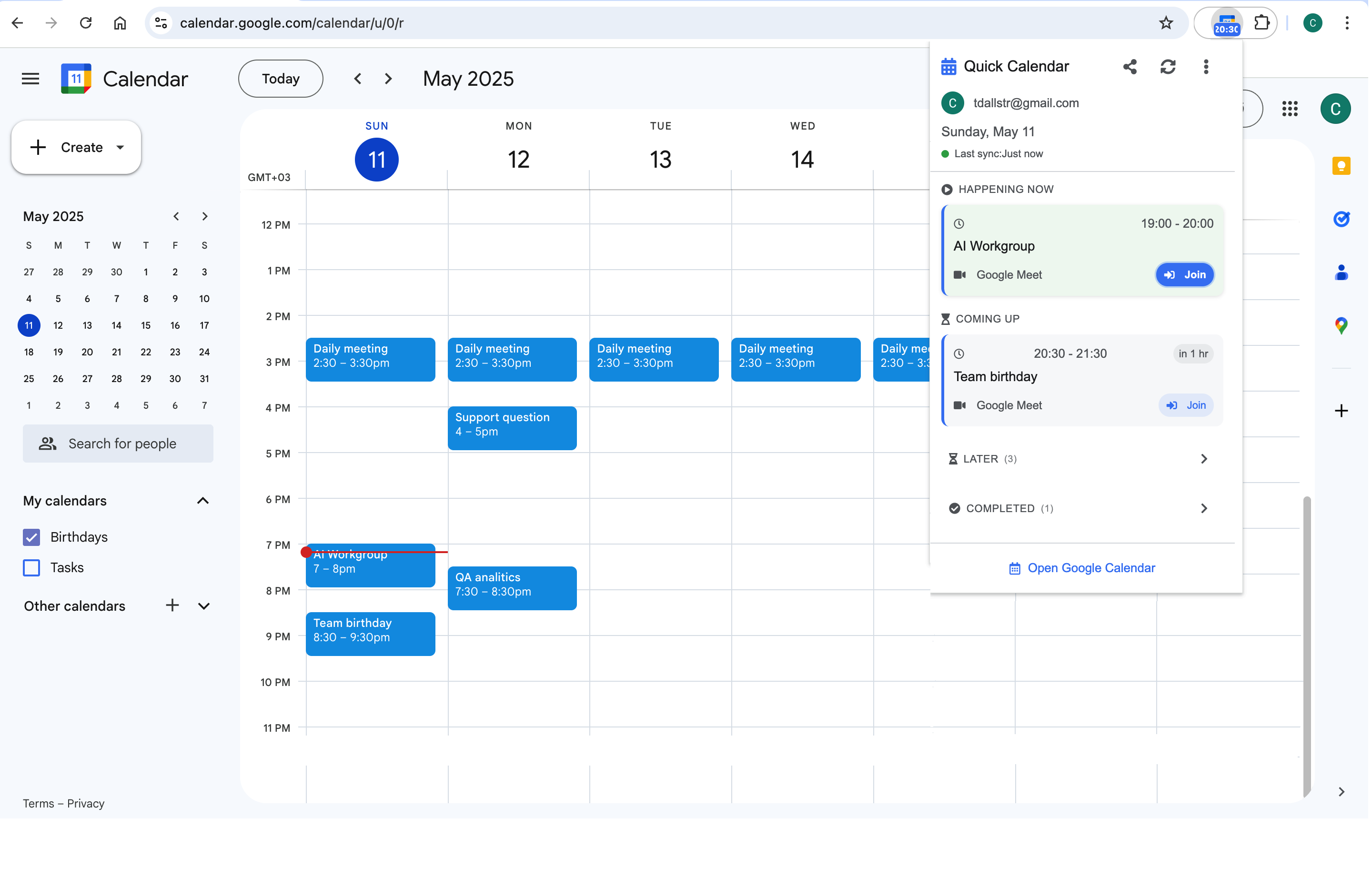
Sparse calendars make glances more useful, not less: the question shifts from "when’s my next meeting" to "what closes today and is my block intact" — exactly what a one-click day strip shows. Calendar Extension for Google Calendar™ renders the closes-events, windows, and blocks in one look, which is the async day’s entire dashboard.
Frequently asked questions
The async substrate changes the calculus: with only 2–4 sync slots a week, rotating their burden quarterly is cheap, and the split-double pattern (two editions, one doc spine) covers the rest. Teams fight over sync slots in proportion to how many they hold; async-first makes fairness affordable.
"Within one working day, in your timezone" is the robust default — fast enough for progress, slow enough to protect focus. The critical pair: an explicitly faster channel for genuine urgency (paging, a phone call) so the one-day SLA never gets eroded by exceptions claiming to be emergencies.
Yes — they are trust vehicles, squarely in the survivor list. What changes is their content: status migrates to the shared doc updated beforehand, and the live time spends itself on growth, friction, and disagreement. Fortnightly 25s with a strong doc beat weekly 50s with readouts.
Bound them like meetings — fixed start, fixed end, notification at the exit — and route the overflow honestly: a thread backlog that never fits two blocks is a load signal (too many decisions in flight), not a scheduling failure. Async teams audit thread volume the way meeting teams audit meeting hours.