Why 30 became the default (and why it’s wrong)
Thirty minutes is the calendar grid’s default snap, not a researched unit — and Parkinson’s law does the rest: the decision that needed eight minutes acquires twenty-two minutes of context-setting, recap, and "while we’re here". The 15-minute meeting attacks the padding, not the conversation. Teams that adopt it for the right meeting types report the same discovery: nothing was lost, because nothing removed was content.
The format (it is not "a 30 cut in half")
- The invite carries the decision question, phrased as a question: "Approve the pricing change for Tier 2?" — not "Pricing sync". Attendees arrive knowing what yes/no/blocked looks like.
- Context ships before, not during. One pre-read link, two minutes max to absorb, attached to the event. The 15-minute format’s entire trick is moving the first ten minutes of a normal meeting (context download) into async.
- Start at the question. No recap round — the pre-read was the recap. First sentence: "Given the doc, are we approving?" Disagreement then spends the time productively; agreement ends the meeting at minute six, which is allowed and celebrated.
- Last two minutes: owner and date. The decision gets a writer-downer (event description works), the action gets an owner, and anything surfaced-but-unresolved gets its own future 15 — not an extension of this one.
Where 15 fits — and where it honestly doesn’t
Fits: single decisions with shipped context, status checks between two people, unblocking sessions ("what do you need from me?"), quick reviews of a specific artifact, and the recurring 1:1s that had drifted to ceremonial 30s. Doesn’t fit: anything exploratory (brainstorms need wander time), first conversations (trust doesn’t compress), multi-decision agendas (that is a 25 or a split), and emotionally loaded topics — compressing a hard conversation reads as dismissing it. The skill is triage at booking time, and the default-25 setting makes 15 an active downgrade choice rather than an ideology.
Calendar mechanics that support it
Set default duration 25 and use 15 deliberately per meeting (event editor → duration). Enable Speedy meetings so even the 30s end at :25 — the org-wide gateway drug to shorter units. Schedule 15s at :00 or :30 boundaries adjacent to existing meetings (they slot into the seams of other people’s days, which makes them easy yeses), and resist stacking four 15s back-to-back — the format’s gift is the recovered 15 after it, and a chain of them without seams reinvents the gauntlet at higher frequency.
The failure mode that discredits it
The 15-minute meeting fails one way: the unshipped pre-read. No context before means the fifteen minutes get spent downloading — the meeting runs over, decisions get punted, and "short meetings don’t work here" becomes the lesson. The fix is procedural, not motivational: no pre-read attached by the evening before → the meeting auto-converts to async ("answer in the thread") or reschedules. Protecting the format’s reputation is worth more than any single instance.
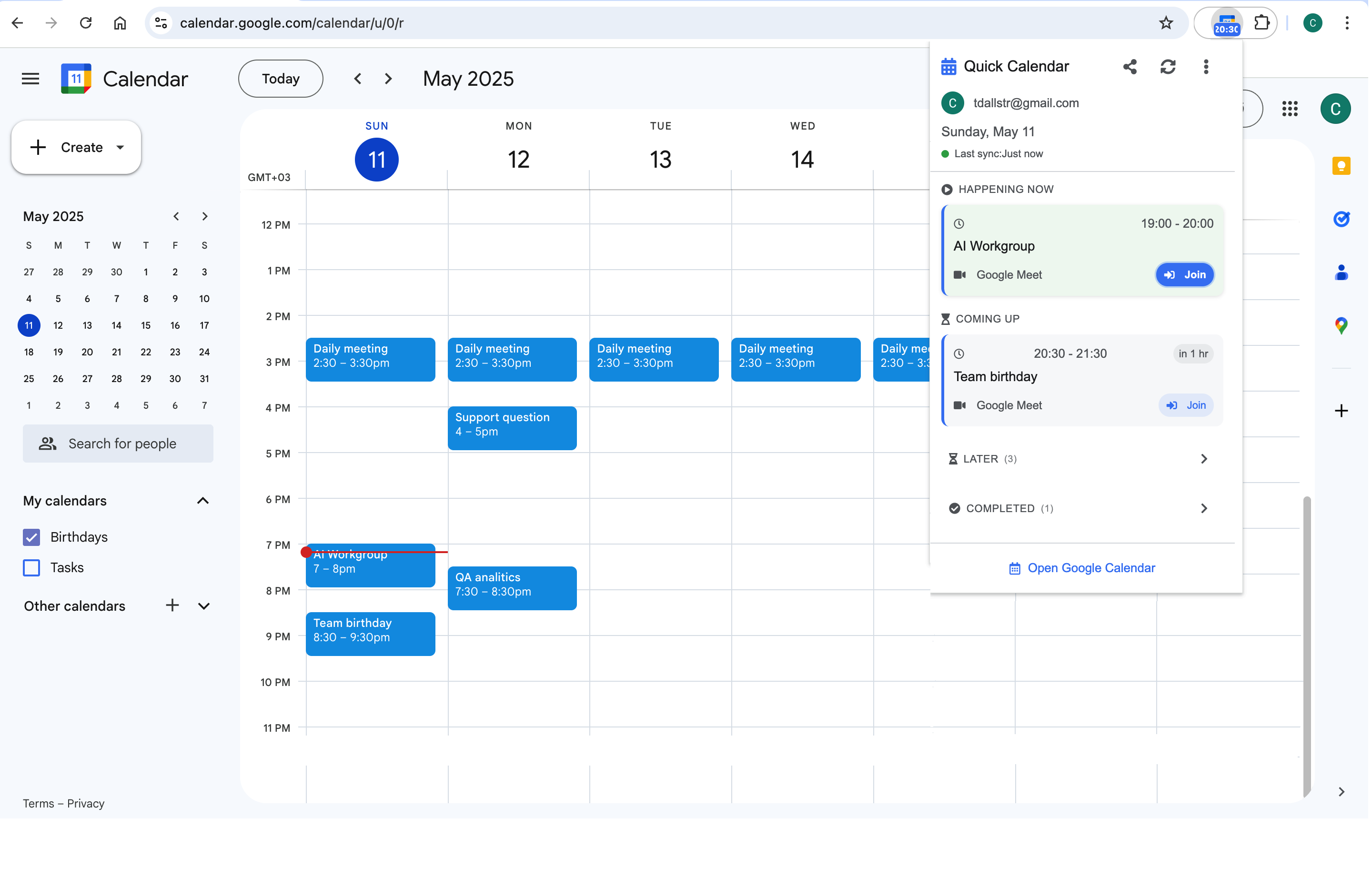
Fifteen-minute meetings sharpen the punctuality math — three late minutes is a fifth of the slot. The countdown chips and one-click joins in Calendar Extension for Google Calendar™ are disproportionately useful at this format size: the transition is the overhead, and the toolbar removes most of it.
Frequently asked questions
Announce the experiment, not the verdict: "Trying 15 for the next four — decision question in the invite, context in the doc by Tuesday night." Edit the series (This and following), run four instances, and let the on-time endings make the argument. Reverting is one edit if it genuinely needs 30.
Especially well — short slots fit overlap windows that 30s fight over. The pre-read discipline matters double, though: the async context is the meeting for whoever’s 7:00 it lands on, and a missing doc costs them the whole slot.
Only until the norm flips: the first early ending feels abrupt, the fifth feels like respect. Saying it out loud helps the transition — "that’s a decision; everyone gets nine minutes back." Teams acclimate to celebrated endings within a month.
Real, and worth budgeting deliberately rather than smuggling: keep the 1:1s at 25 with explicit space for it, and let decision meetings be decision meetings. The failure isn’t small talk existing; it is every meeting paying a ten-minute social tax regardless of purpose.