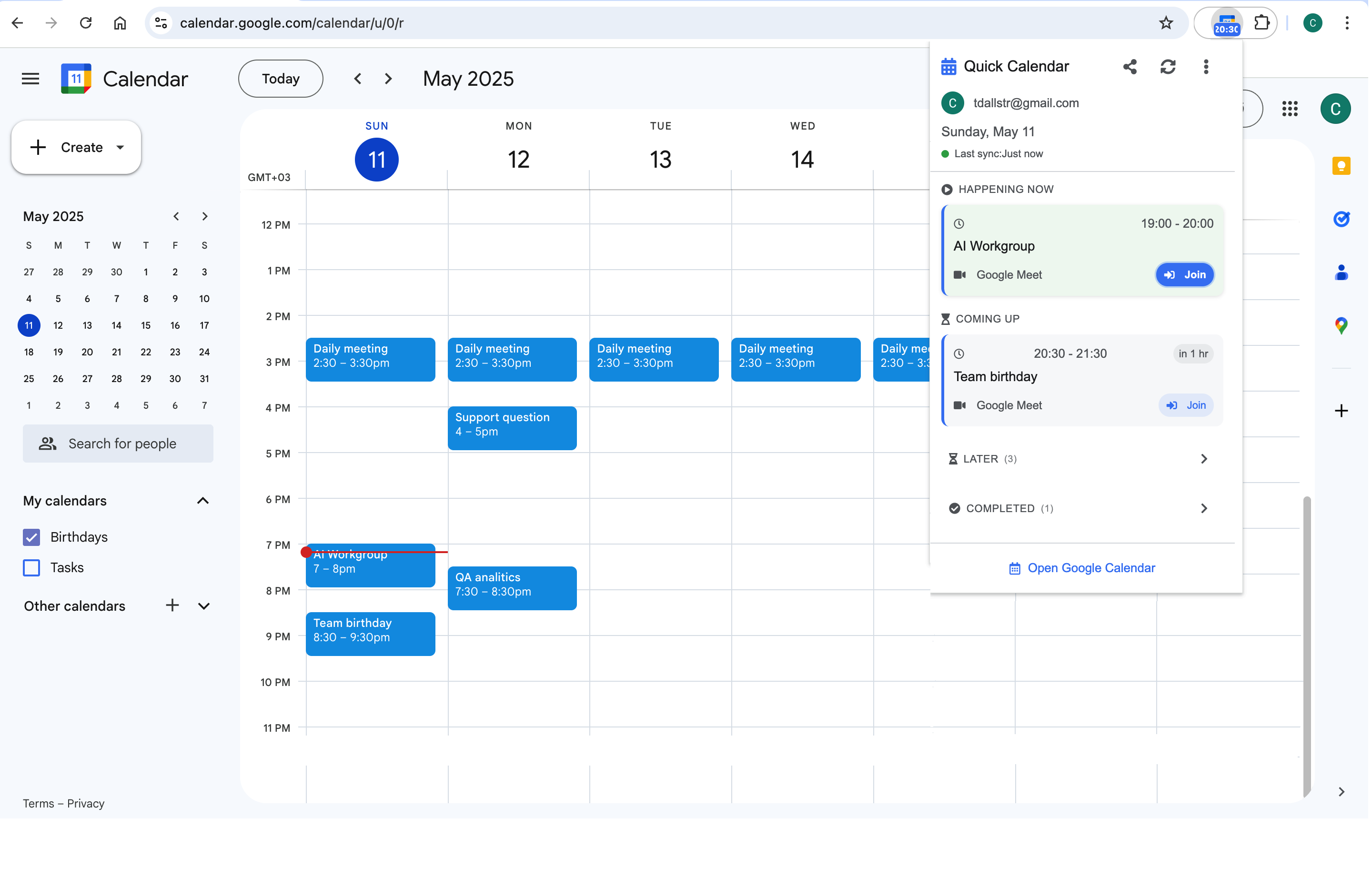
The Problem With the Calendar Tab
Opening your calendar in a browser tab works fine as a planning tool. As a schedule-checking tool — used ten or fifteen times per day to answer 'what is next?' — it introduces unnecessary friction. You navigate away from what you are working on, wait for the calendar to load, find the current day, read the events, and navigate back. The whole sequence takes fifteen to thirty seconds, which does not sound like much until you do it dozens of times per day.
What a Chrome Extension Does Differently
A calendar Chrome extension reads your Google Calendar data and displays it in a popup that appears when you click the toolbar icon. No new tab opens. No navigation happens. You see your next events immediately and return to your work. The calendar did not change — you just changed how you access the most common piece of information you need from it.
For routine schedule checks, this is unambiguously faster. For planning sessions — weekly review, scheduling new events, managing recurring events — the full Google Calendar interface remains the right tool.
A Chrome extension for calendar access and the full Google Calendar tab are not competing tools. They serve different use cases: the extension for quick checks throughout the day, the full calendar for planning and management sessions.
When a Chrome Extension Wins
- Checking how long until the next meeting without interrupting a focus session.
- Confirming a meeting time when someone asks in a message thread.
- Verifying your schedule before accepting a new meeting request.
- Quickly checking tomorrow's first event at the end of the workday.
- Joining a meeting via the conference link in the popup without opening the full calendar.
The Accumulation Argument
Individual calendar checks are fast regardless of method. The difference becomes meaningful at scale. If a Chrome extension saves ten seconds per check and you check twenty times per day, that is three minutes per day, fifteen per week, sixty per month. More importantly, it is sixty fewer context breaks — the cost of those is higher than the time they consume.
How Schedule Calendar helps
Schedule Calendar is a lightweight Chrome extension that shows your Google Calendar events in a toolbar popup. Click the icon, see your next few events with times and countdowns, and return to work. No account required beyond Google authorization, no subscription, no complex setup. It is designed to cover exactly the use case the full calendar tab handles poorly: the quick, repeated schedule check.
Frequently asked questions
A Chrome extension shows your calendar events in a popup without switching tabs or navigating away from your current work. For the most common calendar use case — checking what is next — this is significantly faster and less disruptive than opening a full calendar tab. The full tab remains better for planning, creating events, and managing settings.
Reputable calendar extensions use Google OAuth authorization, meaning Google handles the authentication and the extension receives only the calendar access you explicitly grant. Check the extension's permissions before installing and confirm it requests only calendar read access rather than broader account permissions. Extensions from the Chrome Web Store are reviewed by Google.
No. A calendar Chrome extension is a view layer on top of Google Calendar, not a replacement for it. You still use Google Calendar directly for planning sessions, creating events, managing sharing, and editing recurring events. The extension handles the high-frequency quick-check use case that the full calendar tab handles less efficiently.
The time saved per individual check is small — typically ten to twenty seconds. Across fifteen to twenty daily schedule checks, the time accumulates to a few minutes per day. More importantly, each avoided tab switch is a smaller context break, which matters disproportionately during focused work. The total value is in reduced interruption as much as in raw time saved.
Yes, if the extension displays conference links with the event. Schedule Calendar shows Google Meet and other conference links directly in the event popup, so you can click to join without opening the full calendar tab. This is especially useful for joining meetings from any browser tab without navigating away from your current work.
The most important features are: clear display of upcoming events with times and countdowns, access to conference join links, visual display of Google Calendar colors, and a lightweight design that does not slow the browser. Nice-to-have features include multi-calendar display and a daily event list. Avoid extensions that request unnecessary permissions or access beyond calendar data.