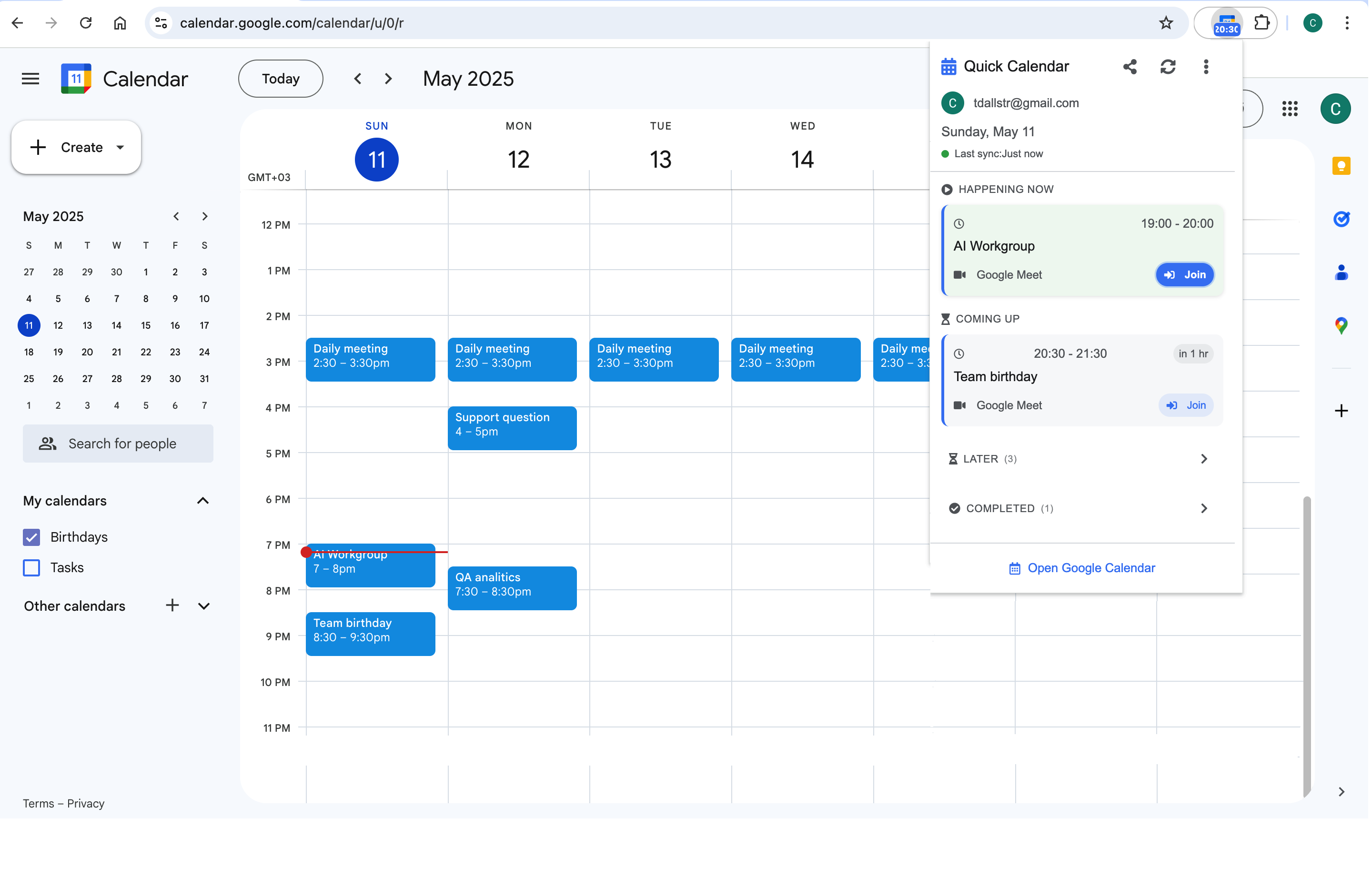
The gap is a budget you can’t spend blind
Between commitments, every choice of what to do next is implicitly sized: starting a deep task with 12 minutes left is a write-off (you’ll pay the entry cost and be interrupted before producing), while spending a 70-minute gap on inbox grazing is the opposite waste. People without the number default to the safe-feeling choice — shallow work — because uncertainty about the gap makes deep starts feel risky. That is the quiet mechanism by which meeting-heavy calendars produce shallow days even in their gaps.
The decision rules a visible number enables
With "43 min until standup" ambient, gap-spending becomes rule-based instead of vibe-based:
- 60+ minutes: a real deep-work session — enter properly, entry cost amortizes.
- 25–60: one bounded unit: a single pomodoro on the current project, one review, one document pass. Not a "quick start" on something big.
- 10–25: the gap list — pre-chosen shallow items that need no warm-up.
- Under 10: meeting metabolism — capture last call’s actions, glance at the next agenda, water. Starting anything else is how you join late with half a thought open.
The rules are trivial; the number is the hard part. Nobody re-derives it 30 times a day by opening the calendar — which is why, without ambient visibility, everyone falls back to the shallow default.
The anxiety dividend
There is a second, quieter payoff. A large share of calendar checks are not information-seeking but reassurance-seeking — "I’m not missing anything, right?" — and each one costs a context switch. A standing countdown answers the reassurance question preemptively: the background process that used to interrupt with "check the calendar" goes quiet, because the answer is already in the corner of the screen. Users consistently describe this as the change they didn’t expect: not faster checks, but fewer.
Getting the number ambiently
Ranked by how well they serve the browser-based workday: a toolbar extension with countdown chips — Calendar Extension for Google Calendar™ shows "in 23 min" on each upcoming event, one click from any tab, which makes the gap rules executable mid-work; a menu-bar next-event app (the native-desktop equivalent); the phone widget (for away-from-desk moments); and — the weakest option — the pinned calendar tab, which has the information but demands a tab-switch to consult it, re-introducing the exact cost the number was meant to remove.
One habit to pair with it
The number changes behavior only when consulted before choosing the next action — so attach it there: end of any task or meeting, the sequence is glance → rule → go. Two weeks of that pairing and it runs itself; the visible countdown plus the four rules quietly re-allocates two or three formerly-shallow gaps a week into real sessions, which is most of what "getting more focus time" was ever going to mean on a meeting-heavy calendar.
Frequently asked questions
The opposite, in practice: anxiety feeds on uncertainty, and the countdown deletes the uncertainty. What spikes anxiety is the surprise meeting at 10:58. People who find any time display stressful can test the claim cheaply: one week with, one without, count the reactive scrambles.
The morning snapshot decays — meetings move, invites land, and by 14:00 your mental model is fiction (that is also why morning-memorizers over-check: they’re validating a stale cache). Ambient visibility is the live feed; the morning look remains useful for shape, not for gap-math.
It scales with your personal entry cost: writers and engineers deep in state-heavy work often need 90+ to bother; ops roles with shallow-deep mixes can use 40-minute gaps well. Calibrate once — how long until you’re genuinely in — and set your own rule boundaries accordingly.
The most-wasted gap in most calendars — no countdown pressure, so it dissolves into drift. Give it a standing assignment instead: the daily close ritual (capture, tomorrow’s first-block note) followed by one bounded unit if energy allows. An end-of-day gap with a job outperforms an open-ended one every time.