What a "quick check" actually costs
The calendar check itself is trivial — you need one fact, like "when is my next meeting?" The cost is the route: switch to the calendar tab (or worse, re-open it), wait, scan the whole week when you needed one number, then travel back past Gmail and Slack, which bill their own toll. Gloria Mark’s fieldwork put the average return to interrupted work at 23 minutes and 15 seconds (Gallup interview, 2006); a calendar glance doesn’t cost that, but 30 glances a day at even 60 seconds of detour each is a half-hour tax on pure logistics.
The insight that fixes it: most checks need one of three facts — what’s next, when does it start, do I have room before it. Any surface that answers those three without a tab switch eliminates the majority of trips.
Four fixes, cheapest first
1. A toolbar popup (two seconds, zero tabs)
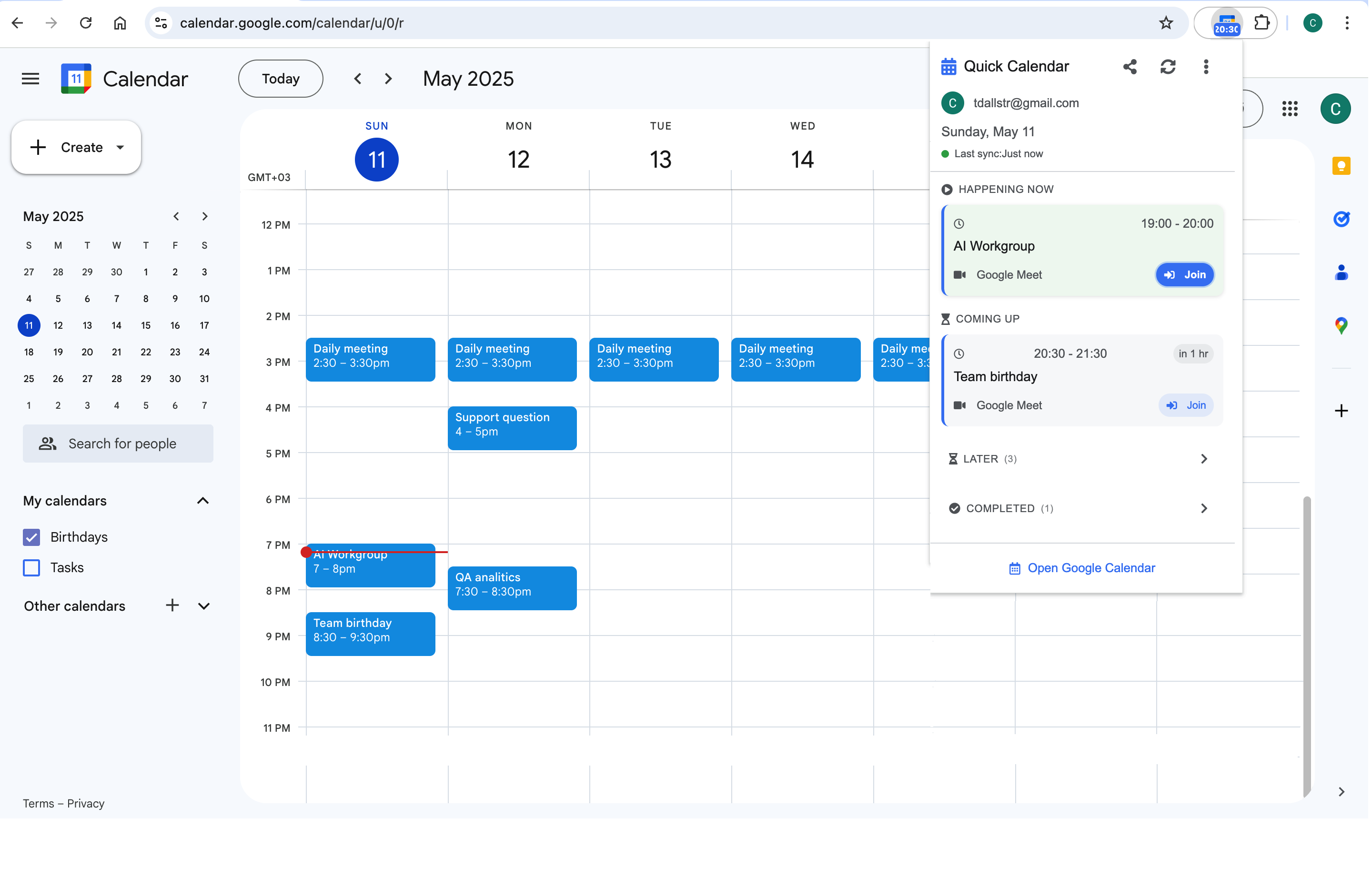
A browser extension puts today’s timeline one click from any page you are on. Calendar Extension for Google Calendar™ shows the day strip, the next events with time-to-start chips, and meeting join links — which covers all three facts and the "join now" action without ever leaving the current context. This is the highest-leverage fix because it replaces the route, not just the destination.
2. Make the remaining tab trips cheaper
For the checks that genuinely need the full calendar, cut the scan cost: learn D / W / M to switch day/week/month view instantly, T to jump to today, and set default view to Day (Settings → View options) so the tab opens showing the one day you care about instead of a wall of week.
3. Move "when is it?" into notifications you trust
Half of calendar checks are anxiety re-checks of a meeting you already know about. Those disappear when notifications are tiered well enough to trust (1 minute for standups, 15+1 for externals) — you stop verifying what the system reliably tells you.
4. Desktop and mobile shortcuts for off-browser moments
On a Mac, the menu-bar clock area can show the next event via Clock settings or a widget; on phones, a home-screen calendar widget makes the glance a pocket action rather than an app launch. These don’t need to be good calendars — they only need the three facts.
A note on the pinned-tab habit
The pinned calendar tab feels like a solution but behaves like a symptom: it exists because checks are frequent, and it makes each check slower than it should be while keeping a whole tab of working memory occupied. Once a toolbar surface answers the three facts, most people find the pinned tab quietly loses its job — the full calendar becomes what it is good at, a planning tool you open a few times a day on purpose.
Frequently asked questions
Measure your own week: count calendar tab visits for two days (a tally on paper works). At 25+ visits, a one-click popup that answers "what’s next / when / how much room" saves 20–30 minutes a week of pure navigation — and removes the Gmail-on-the-way-back detours, which are usually the bigger loss.
Any calendar tool deserves that question. Check three things before installing: what permissions it requests, whether events are processed locally or sent to third-party servers, and whether the developer publishes a privacy policy. Read-only local processing is the standard worth holding out for.
This is where the toolbar surface earns its keep — mid-call is exactly when tab-switching is most disruptive and most visible to others. A popup glance for "how long until my next commitment" happens without sharing your screen chaos or losing the call thread.
Creation is rarer and deserves the full editor, so a tab trip is fine — though quick-add from a popup covers the "block 30 minutes at 3" case. The tax analysis is about checks, which outnumber creations roughly ten to one for most people.