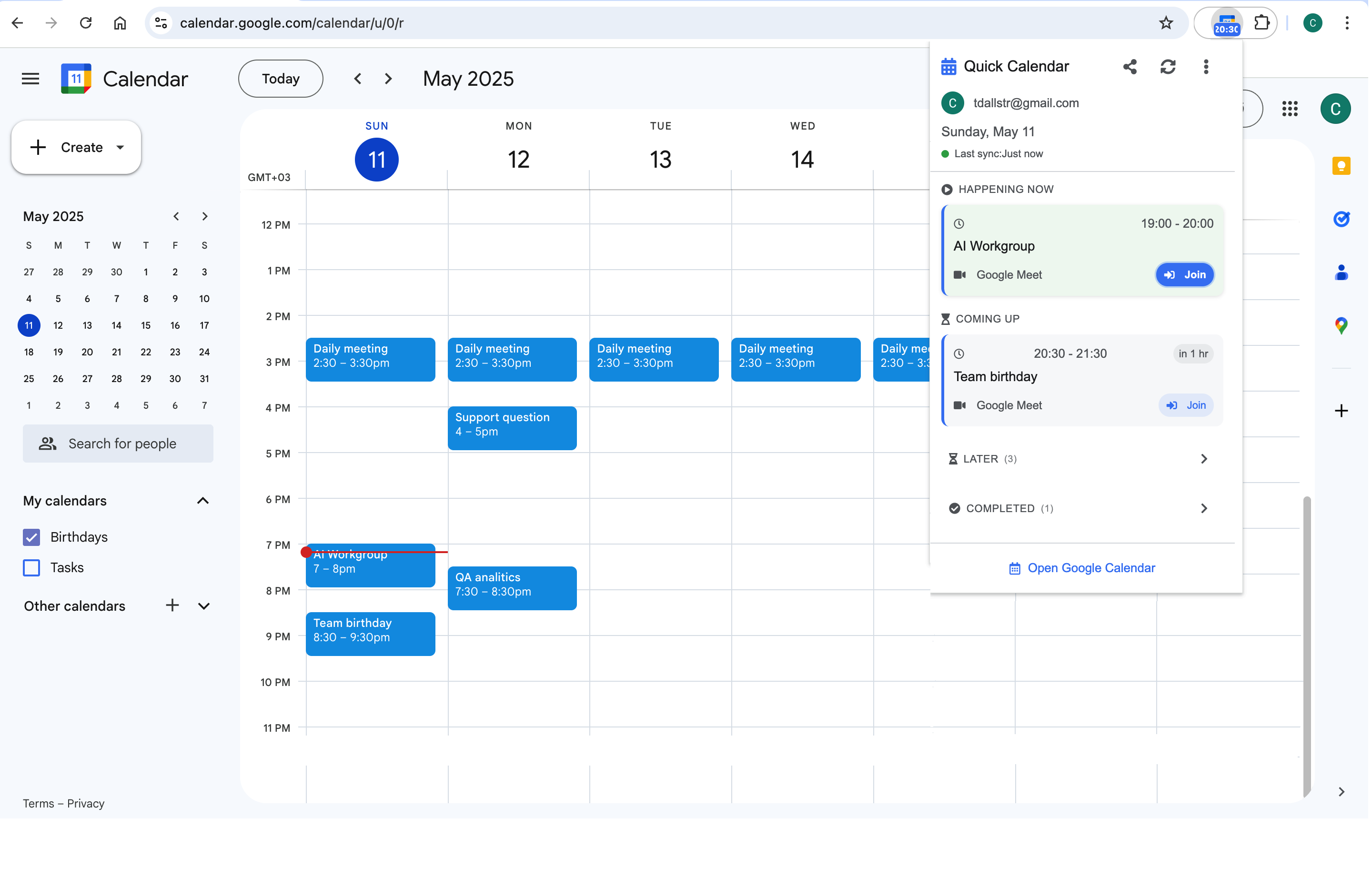
Re-entry is the vulnerable moment
Sophie Leroy’s attention-residue studies point at the same weak spot: transitions are where days leak. After any absence — a meeting, lunch, a focus block — you return holding no context, and whatever you look at first gets to set the next hour’s agenda. Look at the inbox and the inbox decides; look at Slack and Slack decides. The quick calendar check exists to make the schedule the first thing that speaks: what’s next, how long until it, what did I say I’d do with this gap.
The five-second version (the workflow itself)
One glance at a day strip answers re-entry’s three questions in order:
- Am I late for anything? (The now-line and the next event’s countdown — two seconds.)
- How big is this gap? (Next commitment minus now — the number that sizes what you may start.)
- What was the plan for it? (The block’s title, if you left one; the gap-list, if you didn’t.)
Then close the glance and go. The whole point is that the check ends — it produces a routing decision and terminates, which is what separates it from "checking things", the open-ended activity it replaces.
Why the surface determines whether this works
The five-second workflow survives only on a five-second surface. Run through the alternatives honestly: the pinned calendar tab costs a tab-hunt plus whatever Gmail shows you on the way; opening calendar.google.com fresh costs a load plus a login-state gamble; the phone costs a device switch and a lock screen’s worth of other apps’ claims. A toolbar popup — Calendar Extension for Google Calendar™ opens the day strip with countdown chips in one click from whatever page you’re on — is the only version where the check’s cost matches its five-second budget. This isn’t tool enthusiasm; it is the observation that workflows inherit the physics of their surfaces.
Wiring it to the moments that need it
The check is only as good as its triggers. Bind it to the four standard re-entries: post-meeting (before touching anything else — the next thing might be in three minutes), post-lunch (the afternoon’s router), post-deep-block (the exit ramp’s last step), and post-interruption (after any "quick question" that ran long). Two weeks of deliberate pairing and the glance becomes the default first act of every return — at which point the twenty-minute re-entry detours simply stop happening, not through discipline but because the routing decision now happens before the badges get their audience.
What the quick check is not
Scope protects it: no RSVP processing (that’s the midday check), no replanning (that’s a session, take it to the tab deliberately), no inbox (obviously). The moment the quick check grows features, it inherits their costs and stops being quick — and re-entry goes back to being the leak it was.
Frequently asked questions
Time it: click, read three chips, close — with a one-click surface it is genuinely 4–8 seconds. What inflates it is surface friction (tab hunts, loads) and scope creep (processing invites mid-check). Keep both out and the budget holds all day.
Then it just paid for a week of itself: join from the popup’s button (one click), apologize once, and note what killed the notification — usually a DND setting or a dismissed banner. The check is the backstop for exactly this failure class.
Anywhere one click away: Google Tasks’ panel, a pinned note, the block description. The requirement is only that re-entry’s "what was the plan?" resolves in seconds — a plan that needs finding isn’t a plan yet.
Even more: with no external deadline, the routing decision is the only structure the afternoon gets. The glance then reads "no commitments until 17:00" — which converts to "one deep session plus a shallow batch" via your standing gap rules, instead of converting to drift via the inbox.