What "lightweight" means concretely
Lightweight is not a vibe; it is measurable properties. A lightweight calendar tool:
- answers its core question in under three seconds — what’s next, when, how long until;
- adds no second source of truth — it reads the calendar you already have rather than importing your life into a new database;
- survives ignoring it — no streaks, no inbox of its own, no "you have 14 unprocessed items";
- costs one gesture — a toolbar click or a widget glance, not an app launch and a login.
By this definition, a Google Calendar toolbar extension is lightweight; a scheduling super-app with its own tasks, notes, and AI copilot is not — regardless of how clean its landing page looks.
Why less wins for most people
The maintenance tax is the real price
Every capability a tool adds is a small recurring obligation: categories to keep meaningful, integrations to re-authenticate, an inbox to zero. Heavy tools bill you weekly in upkeep for features you used twice. Lightweight tools are cheap to own precisely because there is nothing to maintain — the calendar stays the single source of truth, and the tool is just a faster window into it.
Migration risk is real risk
Tools that ingest your scheduling life create an exit problem: when the startup pivots or the subscription doubles, your workflows leave with it. Tools that sit on top of Google Calendar can be uninstalled in one click with zero data hostage. Prefer window-tools over warehouse-tools unless the warehouse pays extraordinary rent.
Speed compounds; features don’t
You will check the calendar thirty times today and use the fancy planning canvas twice a month. A tool that makes the frequent action twice as fast beats one that makes the rare action twice as powerful — the arithmetic is not close.
Where heavier tools earn their keep
Honesty clause: some jobs are heavyweight. High-volume external scheduling (recruiting, sales) justifies a booking-link product. Team resource planning across dozens of people justifies real workforce software. EAs running multiple executives’ calendars justify power tooling. The pattern: heaviness pays when scheduling itself is the job. When scheduling is overhead around your actual job, every gram counts against it.
A stack that stays light
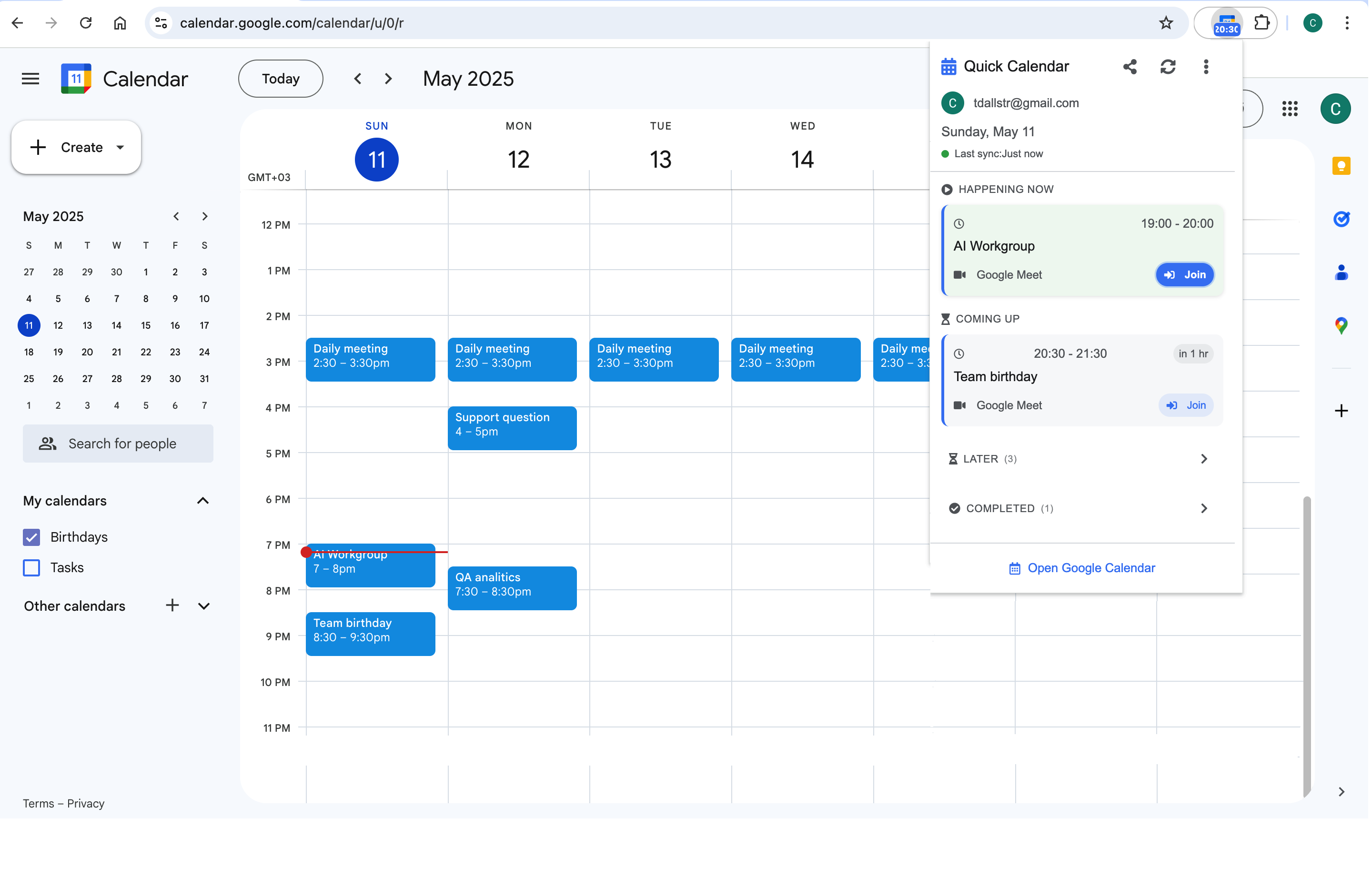
The whole setup: Google Calendar as the single source of truth, tuned (speedy meetings, tiered notifications, few calendars). A toolbar popup for the thirty daily glances — Calendar Extension for Google Calendar™ does exactly the four lightweight properties above: day timeline, time-to-event chips, join links, quick add, all reading your existing calendar. A phone widget for pocket checks. Total new databases created: zero. Total daily maintenance: zero.
Frequently asked questions
The tab is heavy in the ways that matter: it holds working memory hostage, invites detours through neighboring tabs, and shows a planning UI when you needed one fact. The extension inverts it — two-second access from any page, and the full tab returns to being a deliberate planning tool.
No — it means adding those capabilities only where volume justifies them. Google’s built-in appointment schedules cover casual booking needs without a new product; a dedicated booking tool becomes rational at recruiter or sales volumes.
Three things: the permission scope it requests (read-only is the default to prefer), where event data is processed (locally versus third-party servers), and whether there is a published privacy policy with a named developer. Lightweight architecture usually correlates with lighter data handling — but verify, don’t assume.
Sometimes! The test is whether the tool’s one job is done excellently — a popup that takes four seconds to load has no excuse. Judge lightweight tools on speed, reliability, and restraint; judge heavyweight tools on whether you actually use the weight.