Anatomy of the scramble
Watch anyone join a video call from a busy browser and the sequence is remarkably consistent: notification fires (or anxiety does) → hunt for the calendar among 30 tabs, or re-open it → find the event on the grid → open it → locate the join link among description links → click → arrive at the lobby 40–70 seconds after starting, having dropped whatever context you held. Multiply by 4–6 daily calls: 4–7 minutes of pure navigation, plus 4–6 context drops, every day — the drops being the expensive part, per all the attention-residue math.
Late joins cost more than time
The secondary tax is social: the 90-seconds-late arrival to a 25-minute call consumes the greeting round twice, restarts the intro, and — repeated — becomes a reputation ("we can start, Alex always joins late"). Remote meetings amplified punctuality as a signal precisely because it is one of the few visible behaviors left. The scramble is where punctual people become late people four times a day.
The one-click version
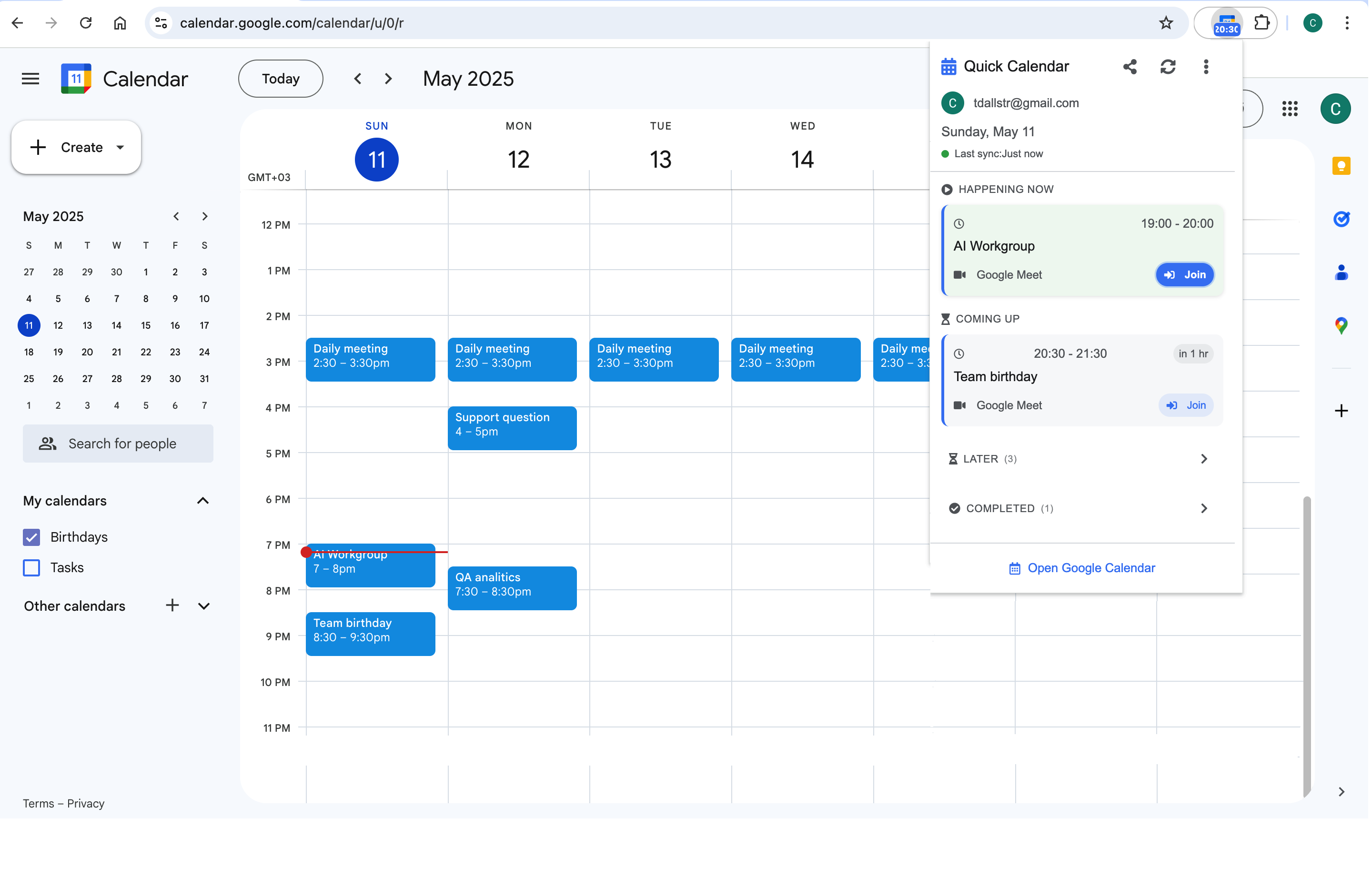
A toolbar calendar collapses the whole sequence: the extension icon shows the day; the imminent meeting carries a join button (parsed from the event’s Meet/Zoom/Teams link); one click opens exactly one correct tab. Calendar Extension for Google Calendar™ pairs the button with time-to-event chips — "in 3 min" — so the join decision happens calmly before the deadline instead of reactively after it. Total cost: two clicks, ~4 seconds, zero hunting, and the context you held survives because nothing was searched.
Supporting cast: three settings that help any setup
- The 1-minute notification on recurring internal meetings — a teleport signal, not prep time. Fifteen-minute warnings for standups train dismissal.
- Auto-add conferencing (Workspace admin or per-event): every event created gets a Meet link by default — the scramble’s worst version is the event with no link at all and a "who has the Zoom?" thread at start time.
- One meeting tab policy: close the dead Meet tabs after each call (or join always from the same surface so duplicates never spawn). Tab archaeology is half the hunt.
The compound effect
Run the arithmetic for a 5-call day: scramble path ≈ 5 × 50s navigation + 5 residue drops; button path ≈ 5 × 4s + 0 drops. Over a work year that is roughly 18 hours of raw navigation — but practitioners consistently report the felt difference is larger than the math, because what actually changed is the texture: meetings stop ambushing the day and start being things you walk into on time, on purpose, with the previous thought intact.
Frequently asked questions
Yes, if the extension parses conferencing links from event data rather than assuming Meet — Zoom and Teams links in the location or description fields surface the same join button. Check this specifically in any tool’s five-minute test; it is the feature that separates real join support from Meet-only shortcuts.
When it fires, it is decent — but it is a moment, not a surface: dismiss it (reflexively, mid-sentence) and you are back to the hunt. The toolbar button is standing access — the join is available at minus-five minutes when you finish your thought, not only at the notification’s instant.
The highest-value case: mid-call, the toolbar shows the next call’s countdown without screen-sharing your tab chaos, and the join is one click the moment you drop. The scramble path at back-to-back time is where 90-second latenesses become five-minute ones.
For walking-between-places moments, yes — the mobile event card’s join button is excellent, and the calendar widget makes it two taps. The desk rule stays the same on both surfaces: join from the calendar object, never from link archaeology in chat or email.