The PM triage: attend where you own the decision
Every meeting wants the PM "for context". The filter that keeps the role from dissolving: attend where you own or materially shape the decision; send written context where you merely hold it. In practice — design reviews for your area: attend. Eng standup: read the thread, attend twice a week at most. Stakeholder alignment on your roadmap: attend. The adjacent team’s planning "in case": one-pager instead, with "ping me if my section raises questions". PMs who apply the filter recover 4–6 weekly hours immediately, and — counterintuitively — their influence rises: written context travels further than a distracted attendee.
Ceremony load: engineered, not inherited
Sprint ceremonies arrive pre-shaped by process templates, but the PM co-owns their calendar shape: stack them (planning + refinement + retro on one or two anchor days protects the rest of the week for maker-and-customer work), shrink by pre-work (refinement with pre-groomed tickets runs 30 minutes, not 90 — the PM’s prep hour buys the team’s collective two), and end-date the experiments — every process meeting added mid-quarter ("let’s sync on the migration weekly") gets eight weeks and a review, or the ceremony stack only ever grows.
Customer contact: scheduled or fictional
Every PM claims customer obsession; the calendar shows the truth. The discipline is a standing weekly customer block — two hours, protected at ceremony rank, spent on calls, support-ticket immersion, sales-call shadowing, or usability sessions, decided weekly by what the roadmap is most uncertain about. Booked as recurring infrastructure, not scheduled per-occasion — because per-occasion customer contact loses every negotiation against internal urgency, which is precisely how PM roadmaps drift into internally-coherent irrelevance.
The thinking block: strategy is a calendar object
The PM deliverables that matter — the narrative, the prioritization call, the "what are we not doing" memo — need the same protection engineers give code: one 90-minute weekly block, output-titled ("Q3 narrative draft", "kill-list review"), held publicly. The PM-specific defense argument, useful with stakeholders: an hour of PM thinking redirects tens of eng-hours — it is the highest-leverage block on the team’s collective calendar, and it is the first thing sacrificed when the PM calendar runs as an open booking surface.
Reading the calendar as a product dashboard
Monthly, three PM-specific counts: decision-ownership ratio (meetings where you owned the decision ÷ total — below half means the filter has eroded), customer hours held (the block’s hold rate is your obsession-claim audit), and upstream/downstream balance — time with stakeholders/leadership vs. time with the team. Sustained drift upstream produces roadmaps that please the org chart; downstream drift produces features nobody asked leadership to fund. The calendar is the early-warning system for both.
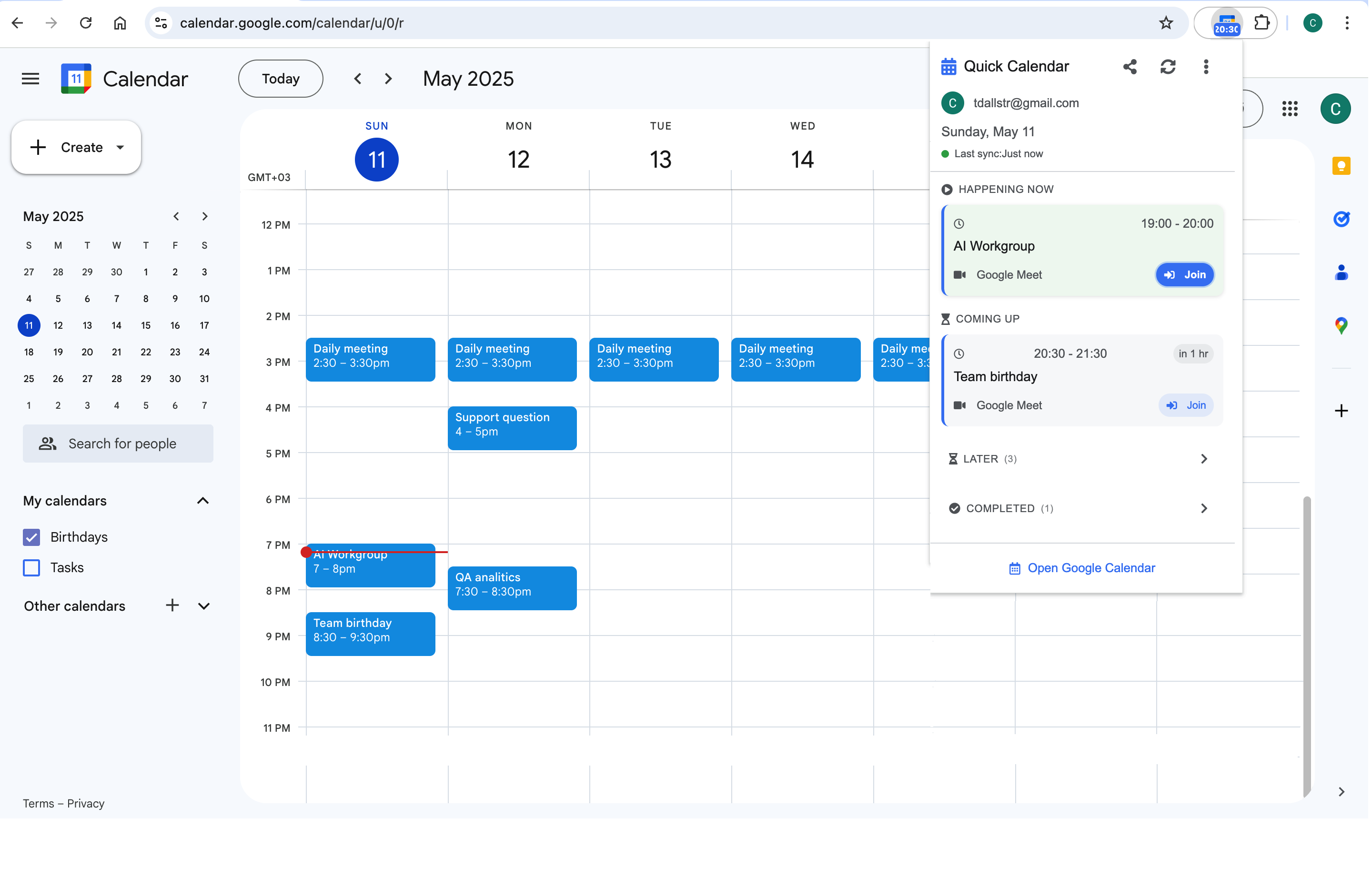
PM days pivot between modes hourly — ceremony, stakeholder, customer call, thinking — and every pivot asks what’s next, whose context to load, how long. A toolbar strip like Calendar Extension for Google Calendar™ keeps that ambient (countdowns, one-click joins), which for the connective-tissue role is the difference between switching deliberately and being switched.
Frequently asked questions
Trade presence for artifacts: "Can’t make it — here’s the one-pager for my area, and I’ll read the notes same-day." Visibility comes from being useful in absence; PMs who master the written-context trade are in more decisions than the ones who attend everything, because their context scales.
Negotiate the real need: usually it is "unblock us fast", which twice-weekly attendance plus a guaranteed async SLA ("standup thread answered by 10:30") serves better than daily distracted presence. Frame it as upgrading your responsiveness, not downgrading your attendance — and honor the SLA religiously.
As declared seasons that suspend the defaults: launch weeks convert the thinking block into launch-command time and pre-announce the customer block’s pause (with a return date). The system’s value in seasons is the explicitness — a suspended block with an end date returns; a silently eaten one doesn’t.
Add the manager layer (1:1 corridor, office-hour windows) and halve the IC surface: your ceremony attendance drops to where you own decisions across the group, and your customer block survives — leads who abandon customer contact at promotion produce teams that do likewise within two quarters.