The manager’s real calendar problem
IC advice ("protect your mornings!") fails managers because availability is part of the job — a lead who is never interruptible is a bottleneck with good focus habits. But pure availability fails too: managers who never think become routers, forwarding decisions they should be making. The architecture that works splits the week explicitly: findable by default, unreachable by appointment — with both states visible on the calendar so the team can navigate them.
The 1:1 system (your biggest standing investment)
Six reports at 30 weekly minutes is three hours — worth engineering. The mechanics: run them as a corridor (stacked with 5-minute seams, e.g., Tue 13:00–16:00) rather than scattered — you stay in coaching mode and your other days keep their shape; cadence by tenure — weekly for new or struggling reports, fortnightly for veterans (ask them; being asked is itself good management); a shared running doc per report linked in the recurring event — agenda accumulates between sessions, status moves to the doc, and the live time spends itself on growth and friction instead of readouts. And the iron rule: 1:1s get moved, never cancelled — a cancelled 1:1 says "you are my slack", and reports hear it precisely.
Office hours: availability with a shape
The ambient "got a sec?" stream taxes both sides: reports feel like interruptions, you get shredded. Convert it: two posted office windows ("door open 11–12 and 16–17, no booking needed") absorb most ad-hoc needs at predictable times. What makes it work is the pairing — genuinely welcoming inside the windows, honestly protected outside them ("catch me at 4 or Slack it") — and the urgent-channel exception stated once. Teams adapt in two weeks and mostly prefer it; the interrupt-guilt was costing them too.
The thinking block: one, sacred, output-titled
One 90-minute block per week is a manager’s realistic thinking budget — and it must be defended differently than an IC’s: your blocks are visible to people who report to you, so what you do teaches. Title it with the management work it produces ("Q3 org plan", "hiring loop redesign", "Dana’s growth case"), hold it at meeting rank, and let the team see both the block and its outputs. A manager whose calendar shows thinking-with-receipts licenses the whole team’s focus blocks; one who preaches deep work while living in back-to-backs licenses the opposite.
Reading your calendar as a management dashboard
Monthly, three manager-specific counts: 1:1 held-rate (moves are fine; a sub-90% held-rate is a relationship debt accruing), your meeting mix — what share is your team’s coordination versus upward/lateral reporting (drift toward the latter is how managers lose their teams while looking busy), and the delegation tell: meetings you attend where your report owns the topic. Each one you exit-with-endorsement ("Dana runs this; she has my proxy") is an hour recovered and a development move — the calendar version of the job’s whole point.
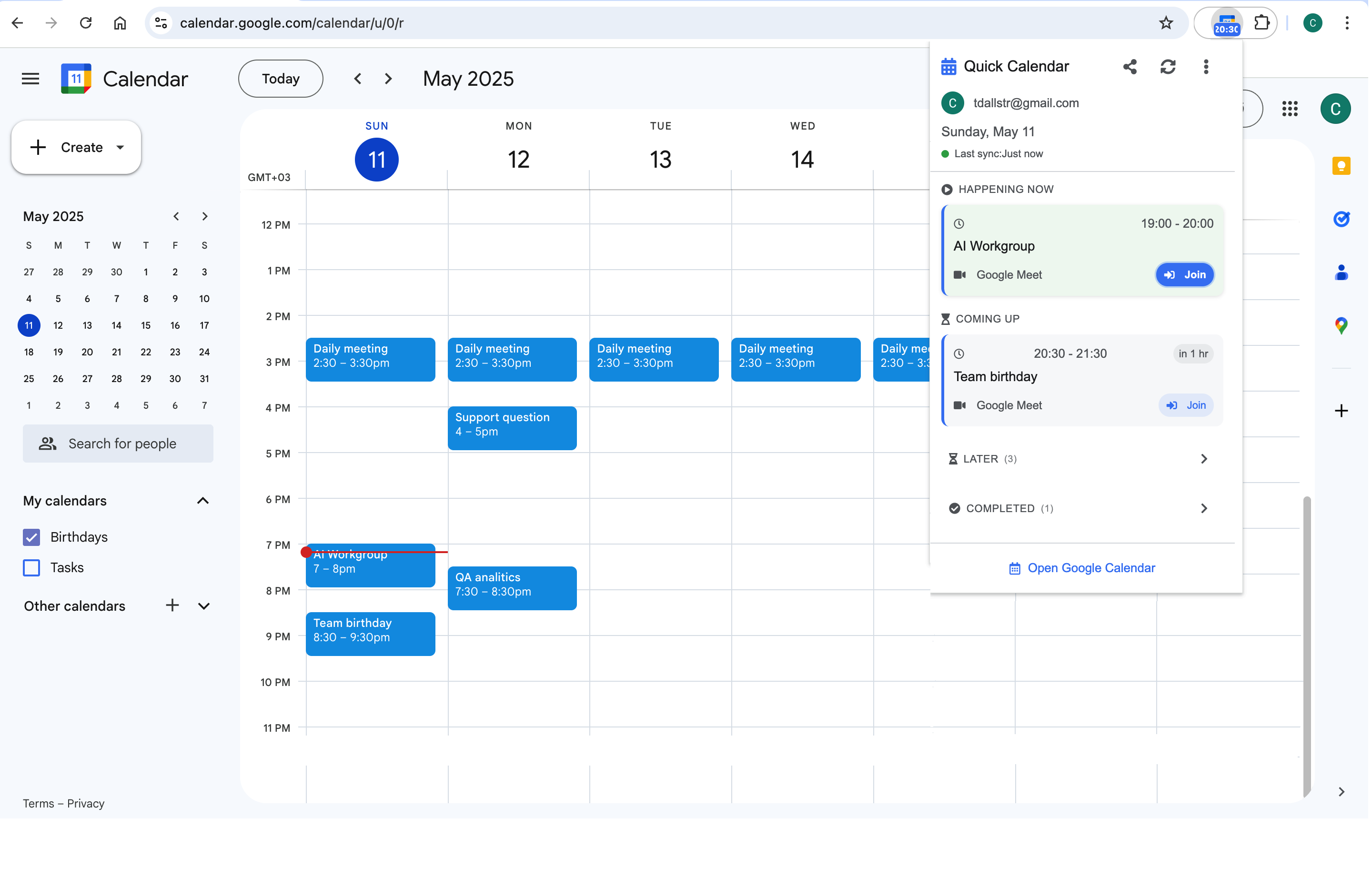
Manager days are transition-dense — corridor 1:1s, office windows, the odd escalation — and each seam asks "who’s next, what’s their doc, how long do I have?" A toolbar strip like Calendar Extension for Google Calendar™ answers per-glance between conversations, which across a six-transition afternoon is the difference between presence and perpetual catch-up.
Frequently asked questions
The corridor outranks almost everything movable: upward meetings usually have more scheduling flexibility than they claim (senior calendars have more slack than yours), and reports notice being bumped for bosses in a way bosses never notice being asked for Thursday instead. Move upward, hold downward.
Same shape, explicit channel: the windows become "on Meet, link in the calendar event, drop in" — with the event visible on the team calendar so it inherits legitimacy. Distributed office hours actually outperform in-office ones: no desk-hovering ambiguity, and quiet reports find a video drop-in easier than an interruption.
The partial-attendance and delegation moves, upward edition: "my part is the first 10 — OK if I drop after?" and "Dana owns this area now; she’ll represent us." Both normalize quickly when framed as development. Your report attending in your place is a gift to three parties, including the meeting.
It optimizes a real thing (access) at the cost of two others (your thinking, and reports’ planning — an always-bookable manager produces meeting-roulette days for everyone downstream). Office hours plus bookable gaps gets you 90% of the access with none of the chaos. Full-open works only for very small teams, briefly.