The calendar as billing record
Every disputed invoice is won or lost on records, and the calendar is the cheapest one you already keep. The system: every client session gets an event with the client’s name prefix ("Acme: revisions call", "Acme: build — homepage"), created at actual start/end times (edit afterward to true duration — the honesty is the point). Month-end, search the client name with date bounds: the billable list assembles itself. Freelancers who bill hourly should go one step further — a dedicated calendar per major client, so the month view is the timesheet, exportable and color-legible at a glance.
The storefront: booking without the email dance
The "when works for you?" thread costs 4–6 emails per client call and reads unprofessional at both ends. The fix is a booking page fed by your real availability: Google’s appointment schedules (free tier covers one page) let clients pick from windows you define, with buffers, daily caps, and lead-time minimums baked in. Three settings matter more than freelancers expect: buffer 15 minutes after client calls (notes while warm — see billing, above), cap client meetings per day (two is plenty; four destroys a delivery day), and offer windows only in your trough hours — peak hours are for the work clients are actually paying for, not the talking about it.
Capacity math: the over-commitment firewall
Freelance over-commitment is a calendar-visibility failure: you said yes to project D because the calendar didn’t show that projects A–C had already claimed the month. The counter-practice, thirty minutes at each month’s start: block delivery time per committed project, forward, honestly — "Acme build: Tue/Thu mornings through the 24th" — at estimated hours +25%. When a new inquiry arrives, the calendar answers the only question that matters ("where would this live?") before your optimism does. If the honest answer is "week after next", that is the quote’s timeline — and clients respect stated capacity far more than missed deadlines.
The boundaries employees get for free
No employer means no ambient working-hours norm — you set the shell or clients set it for you. Publish working hours (booking pages inherit them), keep admin on a fixed weekly block (invoicing, proposals — Friday 15:00, batched, not bled across evenings), and mirror personal immovables as Busy so the Tuesday school run never silently becomes a client slot. The client-facing calendar shows a professional with structure; structure, it turns out, is a sales asset — flaky availability signals flaky delivery.
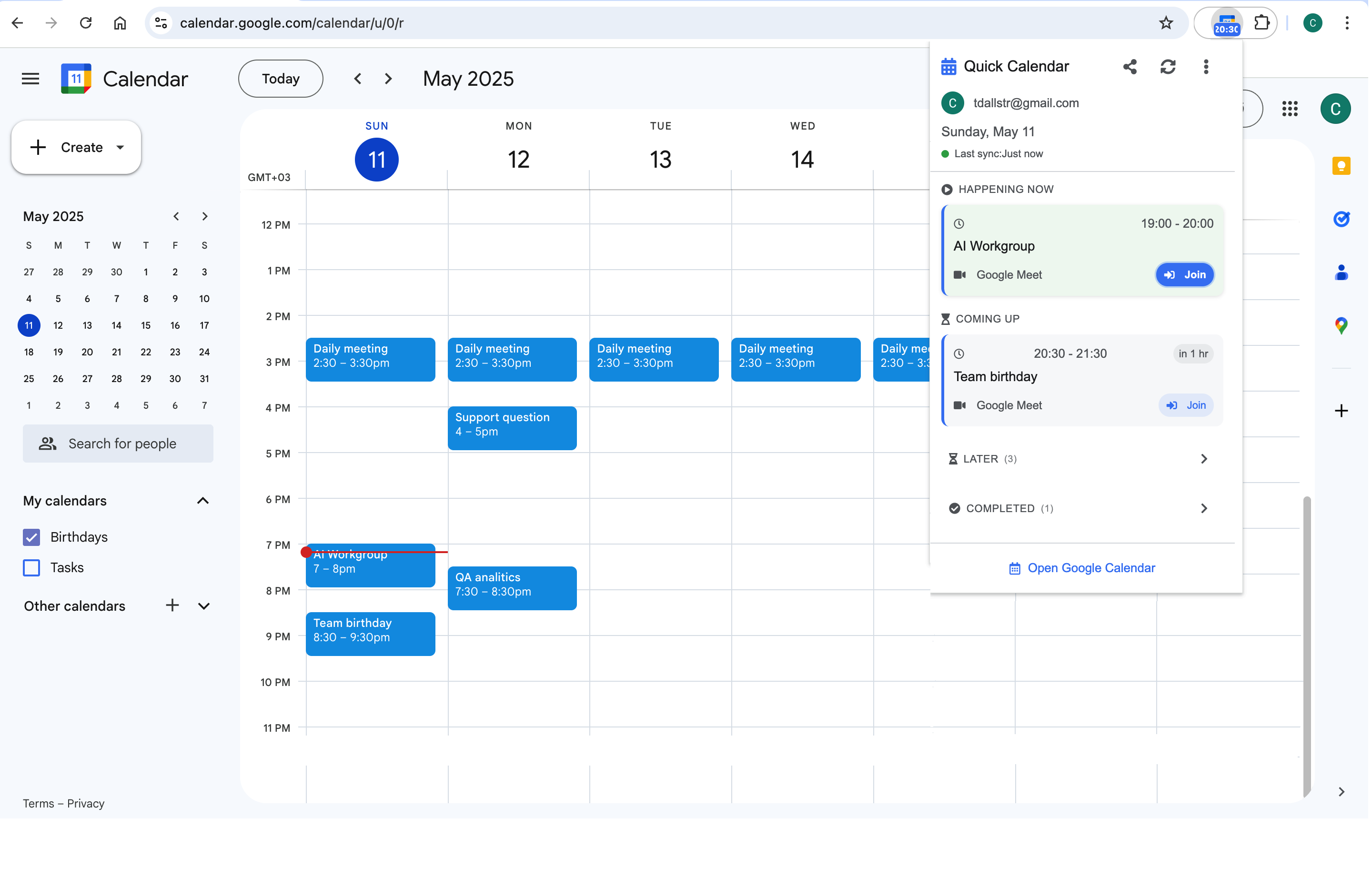
Freelance days switch context between clients constantly, and each switch asks the same questions — what’s next, whose it is, how long until. A toolbar strip like Calendar Extension for Google Calendar™ answers them per-glance with client-colored events and countdown chips, which across a four-client day is the difference between switching and scrambling.
Frequently asked questions
Calendars within your one professional account, almost always: switching accounts costs real friction and clients don’t need account-level separation — they need your availability to be truthful. The exception is embedded contracts where the client issues you a workspace identity; run that in its own browser profile.
Offer free/busy at most — never detail (your calendar names your other clients, which is confidential twice over). The better standing offer is the booking page plus a shared project-milestones calendar for their project only: they see their world fully and your availability honestly, nothing else.
They complement: trackers capture minutes finely, but a tracker with no calendar discipline produces unattributed blobs. Calendar-first (sessions as client-prefixed events) with a tracker running inside the sessions gives you both the dispute-proof narrative and the precise minutes. Solo freelancers with day-rate or retainer billing usually find the calendar alone suffices.
Convert the retainer into visible structure: a standing weekly slot ("your hour: Thu 14:00") plus a stated async SLA for the rest. The calendar object does the boundary-keeping — retainer anxiety is usually access anxiety, and a guaranteed slot cures it better than unlimited ad-hoc ever did.