The calendar is the real strategy memo
Startups mirror their founder’s attention: if the deck says "product-led" and the calendar says forty meetings, the company is meetings-led. The founding discipline is running the week from an allocation, reviewed monthly — e.g., 35% product/customers, 20% recruiting, 20% team, 15% deep work, 10% slack — with the honest count (Time Insights or a Friday tally) held against it. Drift isn’t failure; unnoticed drift is — three months of recruiting-starved calendar is how "we can’t hire fast enough" gets manufactured upstream.
Mode days beat mixed days
Founder context-switching is the most expensive in the building — investor mode, product mode, and firing-decision mode share no mental state. The fix is theming: maker days (two, meeting-free, guarded like payroll — this is where the founder-shaped work that nobody else can do happens), people days (1:1s, candidates, customers — stacked with seams), and outside days (investors, partners, network — batched so the storytelling state loads once). Imperfect adherence still beats perfectly mixed days; even a "mornings are maker, afternoons are people" split captures most of the value at seed-stage chaos levels.
The fundraise exception
Raising is the one season that legitimately overrides the system: 6–10 weeks where the calendar becomes a pipeline instrument — investor meetings batched into tight blocks on consecutive days (momentum and comparability both improve when partner meetings cluster), prep and debrief seams around each (15 minutes: notes, next step, CRM line), and one protected ops block daily so the company doesn’t discover the raise via its own stall. Declare the season to the team with an end date; a raise run as ambient chaos costs double — the round and the roadmap.
Two hours that protect the company from its CEO
Two recurring blocks earn permanent slots. The weekly think (90 min): not email, not slides — the standing appointment with the three questions only the founder can answer (what kills us, what compounds, what am I avoiding?). Titled honestly, held at investor rank. The monthly calendar audit (30 min): allocation vs. actual, the delegation scan (which recurring meetings now have an owner who isn’t you — exit them with endorsement), and the creep check (founder calendars re-fill within weeks; the audit is the immune system). Founders skip both "because fires" — but the blocks are precisely what converts fire-fighting from identity into phase.
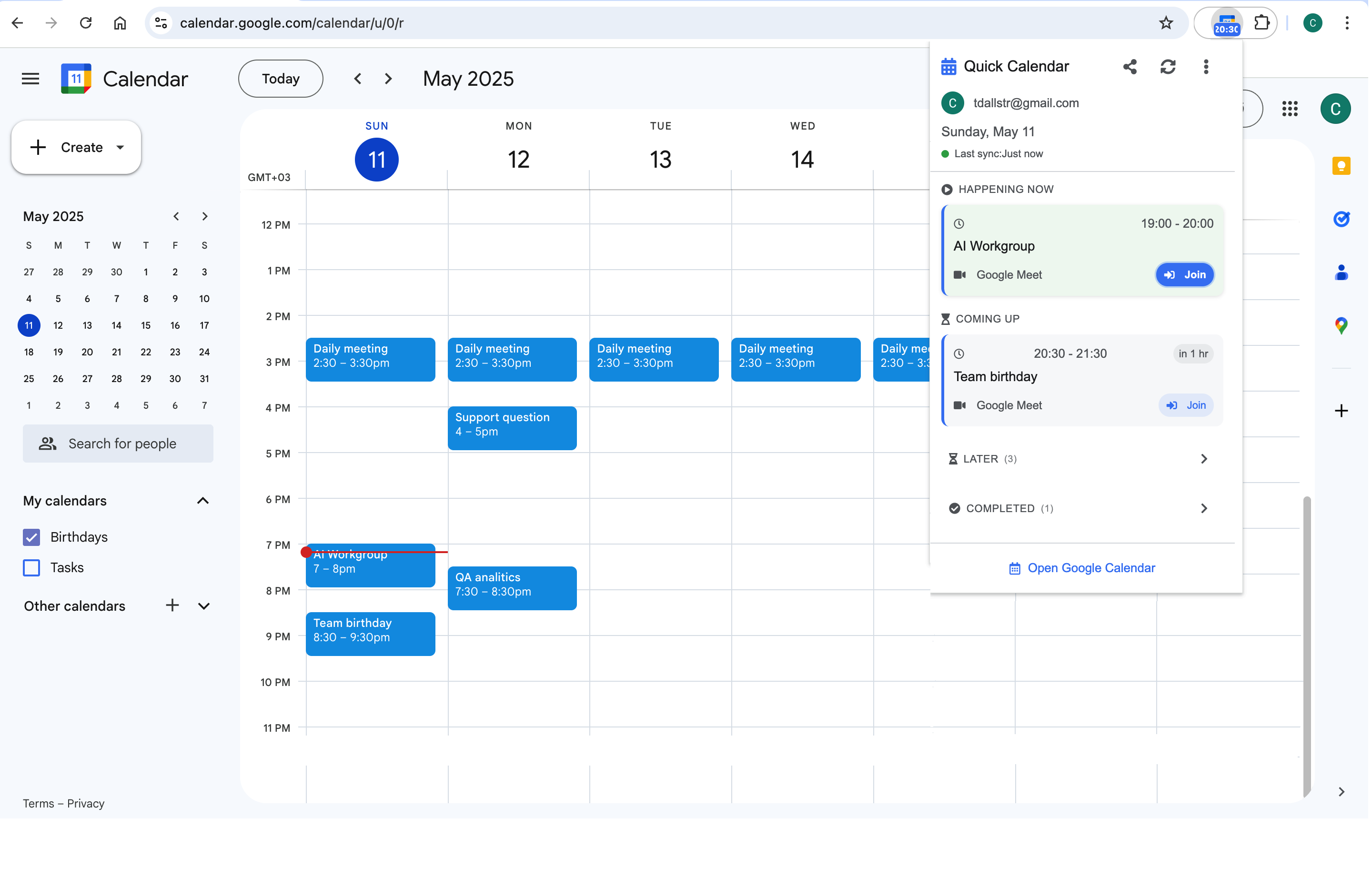
Founder days pivot every ninety minutes — candidate, customer, board prep — and each pivot asks what’s next and how long. A toolbar glance via Calendar Extension for Google Calendar™ keeps the answer ambient (day strip, countdowns, join buttons), which on mode-mixed days is the cheapest co-founder you’ll ever onboard.
Frequently asked questions
Keep two pieces only: mornings-maker/afternoons-everything split, and the weekly think. Allocation targets and mode-days mature in around ten people. What matters at three is that the default is building — a founding team whose calendar defaults to meetings at n=3 has imported big-company disease early.
"We’re heads-down until [date]; can we pick this up then?" burns nothing — it signals traction. Batch the exceptions into outside days, and remember the asymmetry: they take meetings for a living, you build between them. Investors respect scarcity; the ones who don’t are telling you something.
By intent: discovery/feedback calls are product-mode (schedule them adjacent to maker time so insight flows into the build); revenue-closing calls are outside-mode (storytelling state). Founders who mislabel closing calls as "learning" mix modes and do both jobs worse in the same hour.
When triage — not scheduling — exceeds an hour weekly: the tell is inbound requests taking multiple touches to route. First hire is often fractional. What can’t be delegated: the allocation targets and the audit — an EA runs the system, but whose attention goes where is the founder job.