The renewal clock: back-plan from every date
Renewals are lost in the ninety days before them, quietly. The system: every account’s renewal date lives on a Renewals calendar as an all-day event — and each one gets back-planned at entry: T-90 health review block ("Acme: usage + stakeholder map"), T-60 value-review call booked with the champion, T-30 commercial conversation slot held. The back-plan converts renewal season from a scramble into scheduled work — and the Renewals calendar’s month view becomes the book’s risk radar: three renewals clustered in June is a staffing fact you want in March.
QBR machinery: promises at scale
A 30-account book at quarterly cadence is 10 QBRs a month — a scheduling operation. The mechanics: book next quarter’s QBR at this one’s close (while the customer is engaged; chasing calendars cold costs weeks of latency), prep blocks ride with the booking — a 45-minute "Acme QBR prep" two days before, created in the same gesture, because an unprepped QBR is a status call wearing a strategy costume; and tier the cadence honestly — top accounts quarterly, mid-tier semi-annual with async health summaries between, long-tail annual-plus-triggers. Uniform cadence across a tiered book is how CS calendars drown while long-tail accounts still feel neglected.
The reactive-proactive split
CS days fill with inbound — escalations, "quick calls", support-adjacent triage — and the proactive work (adoption plays, expansion signals, health outreach) has no natural defender. The structural fix: proactive blocks are booked infrastructure (daily 90 minutes, mornings before inbound crests, titled by play: "onboarding cohort check-ins", "usage-drop outreach") and reactive work gets containers too — two daily response windows for non-urgent inbound, with the escalation channel explicitly separate. The split’s honest ratio for most books is 60/40 reactive-proactive; unmanaged calendars drift to 90/10, and 90/10 is churn manufacturing.
Escalations without calendar collapse
Real escalations override — that is the job — but the override needs mechanics or every fire consumes a week: the escalation takes the next response window first (most "urgent" survives four hours), true emergencies displace proactive blocks visibly ("moving Acme prep to Thursday" — moved, never vanished), and post-fire, the displaced work gets re-placed the same day. CSMs who run silent displacement discover at T-30 that the renewal prep never happened; the calendar’s job is making displacement expensive enough to notice.
The handoff seams
CS lives between Sales and Support, and the seams have calendar shapes: onboarding kickoffs booked within 48 hours of close (the sales-to-CS handoff meeting with AE present — momentum decays daily), and a weekly support-sync 15 for the accounts on both radars. Both are small; both, skipped, produce the "nobody told me" incidents that burn quarters of goodwill.
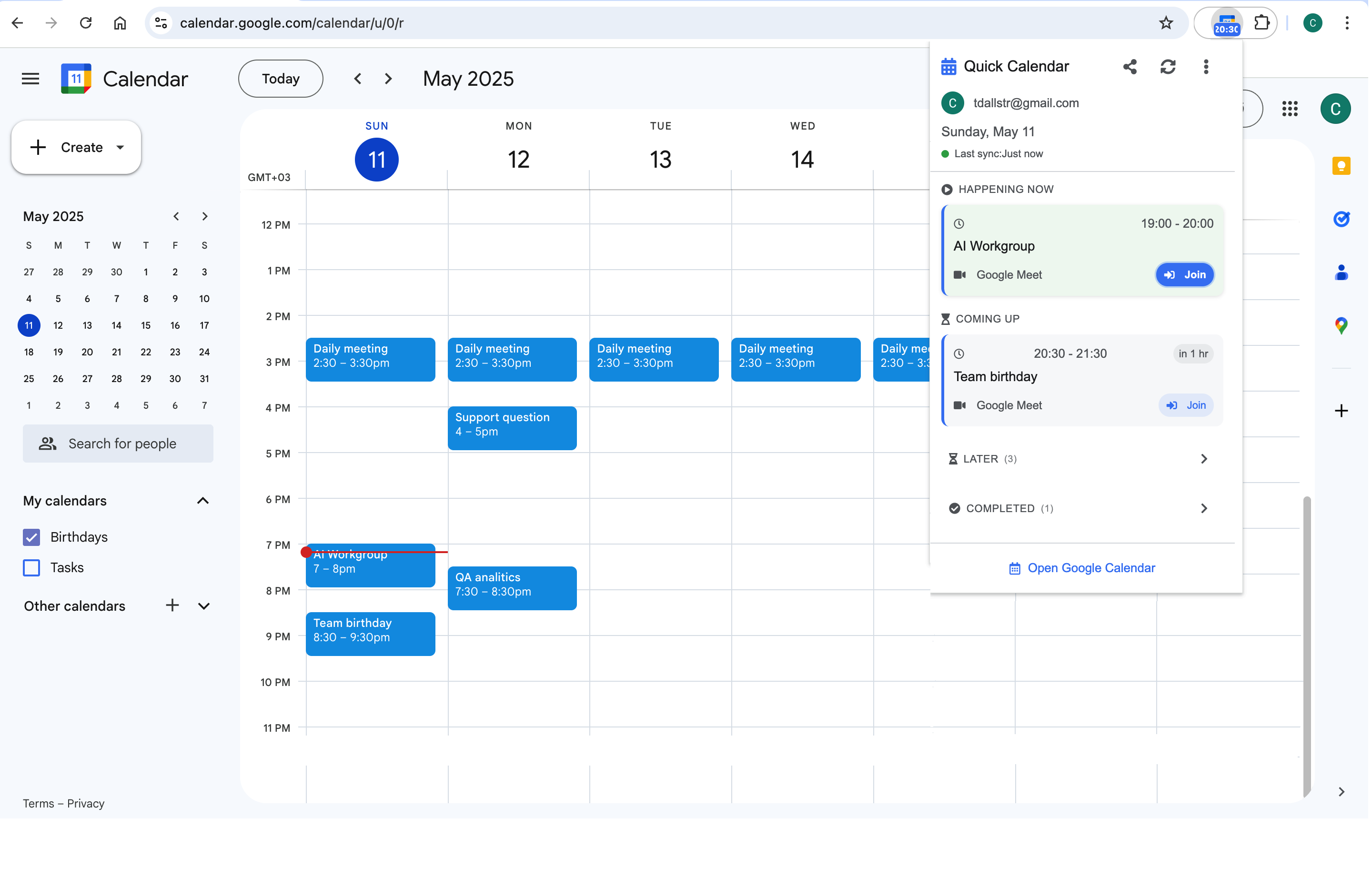
A CS day is account-context whiplash — Acme’s renewal, Beta’s escalation, QBR prep for a third. The toolbar strip in Calendar Extension for Google Calendar™ keeps the whiplash navigable: what’s next, whose context, how long — one glance between calls, with the join button handling the transition itself.
Frequently asked questions
Book at the close of the previous one (acceptance rates near 100% in-meeting), and for the chase cases, send a booking-page link scoped to three specific slots rather than open availability — constrained choice converts better than calendars-at-dawn. The QBR that can’t get booked twice running is itself a health signal; log it.
The structure scales; the depth tiers: top-20 get the full T-90/60/30 build, the rest get T-45 as a single "renewal review" block plus automated health triggers. The non-negotiable at any scale is the Renewals calendar itself — the dates on one visible layer is what makes tiering decisions possible at all.
Signal-spotting is proactive-block work (usage patterns, champion changes, new team adoption); the commercial motion follows your org’s model. Either way, calendar the trigger review: a monthly "expansion signals" pass over the top tier — expansion missed is usually expansion unlooked-for, not undetected.
Roughly 20% — the response windows plus genuine slack. CS calendars need more shock absorption than most roles, but the counterintuitive finding of running the split: escalation volume drops once proactive blocks hold, because proactive work is escalation prevention with a lag. The slack requirement shrinks as the system matures.