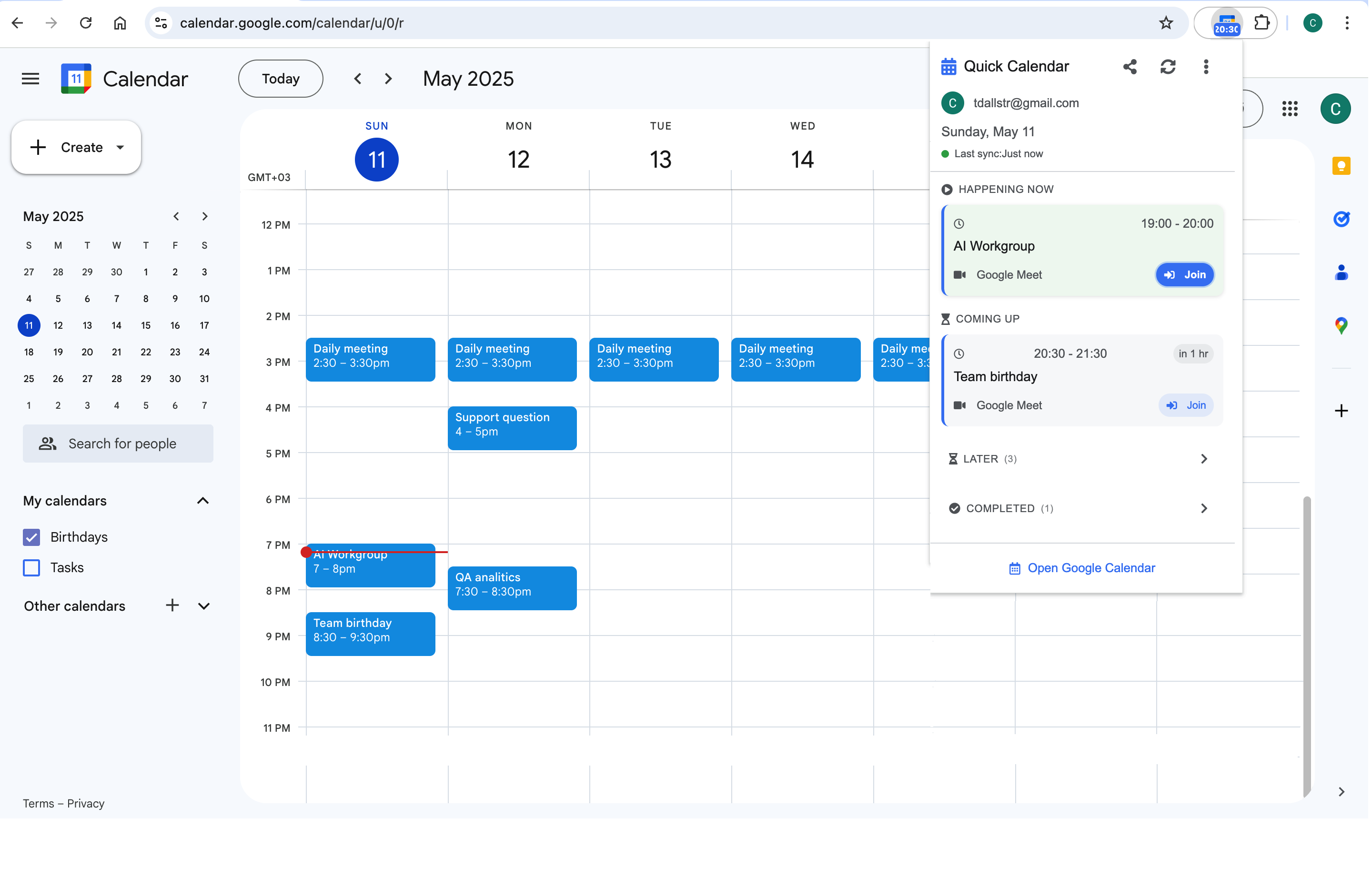
Two interaction types, two tools
Log a normal day and calendar use splits cleanly:
| Checks | Sessions | |
|---|---|---|
| Frequency | 20–40 per day | 2–4 per day |
| Duration | 2–10 seconds | 2–15 minutes |
| Questions | What’s next? When? Room before it? Join. | Plan the week, write invites, negotiate times |
| Right surface | Toolbar popup / widget | Full calendar (tab or app) |
| Cost when mismatched | Tab-switch tax × 30 | Squinting at a popup to plan a week |
Every "extension vs. app" frustration comes from serving one interaction type with the other’s tool: planning a quarter in a 400-pixel popup, or paying a full tab-switch to learn it’s 40 minutes until standup.
What the extension side actually is
A toolbar extension like Calendar Extension for Google Calendar™ is a check-optimized surface: one click from any page → today’s strip, a timeline with a now-line, time-to-event chips, join buttons, quick add. Crucially it creates no second calendar — it renders the Google Calendar you already have, so there is nothing to sync, migrate, or babysit. Its job description ends exactly where sessions begin: the "Open Google Calendar" link at the bottom is not a limitation, it is the boundary working.
What the full app side is for
The Google Calendar tab (or desktop app wrapper — same surface, fewer neighbor-tab ambushes) is session-optimized: week and month layouts, find-a-time grids, the full event editor with guests and rooms, drag-based replanning. Standalone third-party calendar apps compete here too — some with genuinely nice session features (better keyboard languages, natural-text event entry). Evaluate them purely as session tools; none of them fixes the thirty daily checks, which was never their job.
The division in practice
The working setup: popup for checks — morning orientation glance, all "how long until", every meeting join; tab for sessions, opened deliberately — Friday’s weekly reset, invite-writing, any drag-surgery on a broken day; and the pinned always-open calendar tab retired entirely, because it was a check tool paying session rent. People who run this split for a week report the same two things: the tab opens twice a day instead of thirty times, and the "what’s next" anxiety re-checks mostly stop — the answer got cheap enough to stop hoarding.
Frequently asked questions
If your work lives in the browser, an OS-level app is a heavier context switch than a toolbar click — Alt-Tab, different window, different focus. Desktop apps win the check game only for people whose work is outside the browser (design tools, IDEs with no browser open). Match the surface to where your attention already is.
No — the extension is a read-and-light-write view of the same backend, not a copy. Changes made in the tab appear in the popup on next open and vice versa. This "one source of truth, many windows" property is exactly what standalone apps with their own sync layers can’t promise.
The check-tool standard: requested permissions match the job (calendar read, minimal else), a stated privacy policy with processing location, load time under a second (a slow check-tool is a contradiction), and a visible path back to the full calendar for sessions.
One honest niche: wall-calendar mode on a second monitor, glanceable without clicks. If you have the spare screen real estate, that is a legitimate check surface. On a single screen, the pin costs a tab slot and working memory all day to save one click — the math never recovers.