Start with the red flags (they end evaluations fastest)
- Scope greed: an extension whose job is displaying your day but requests write access to all calendars, contacts, or "data on all websites". Permissions should read like the feature list — a display tool wants read access, quick-add wants event creation, nothing wants your browsing history.
- No named privacy policy: if you cannot find, in two minutes, where events are processed (locally vs. their servers), what is retained, and who is behind the product — the answer is the bad one, unstated.
- Slow popup: a glance tool that takes 3+ seconds to open has failed at its only job. This one you feel in the first minute of testing; believe it, it does not improve.
The seven features that earn the toolbar slot
1 · The three answers, instantly
What’s next, when does it start, how much room before it. This is the core loop; everything else is garnish. Test: open the popup and count seconds until you know all three.
2 · A real timeline, not just a list
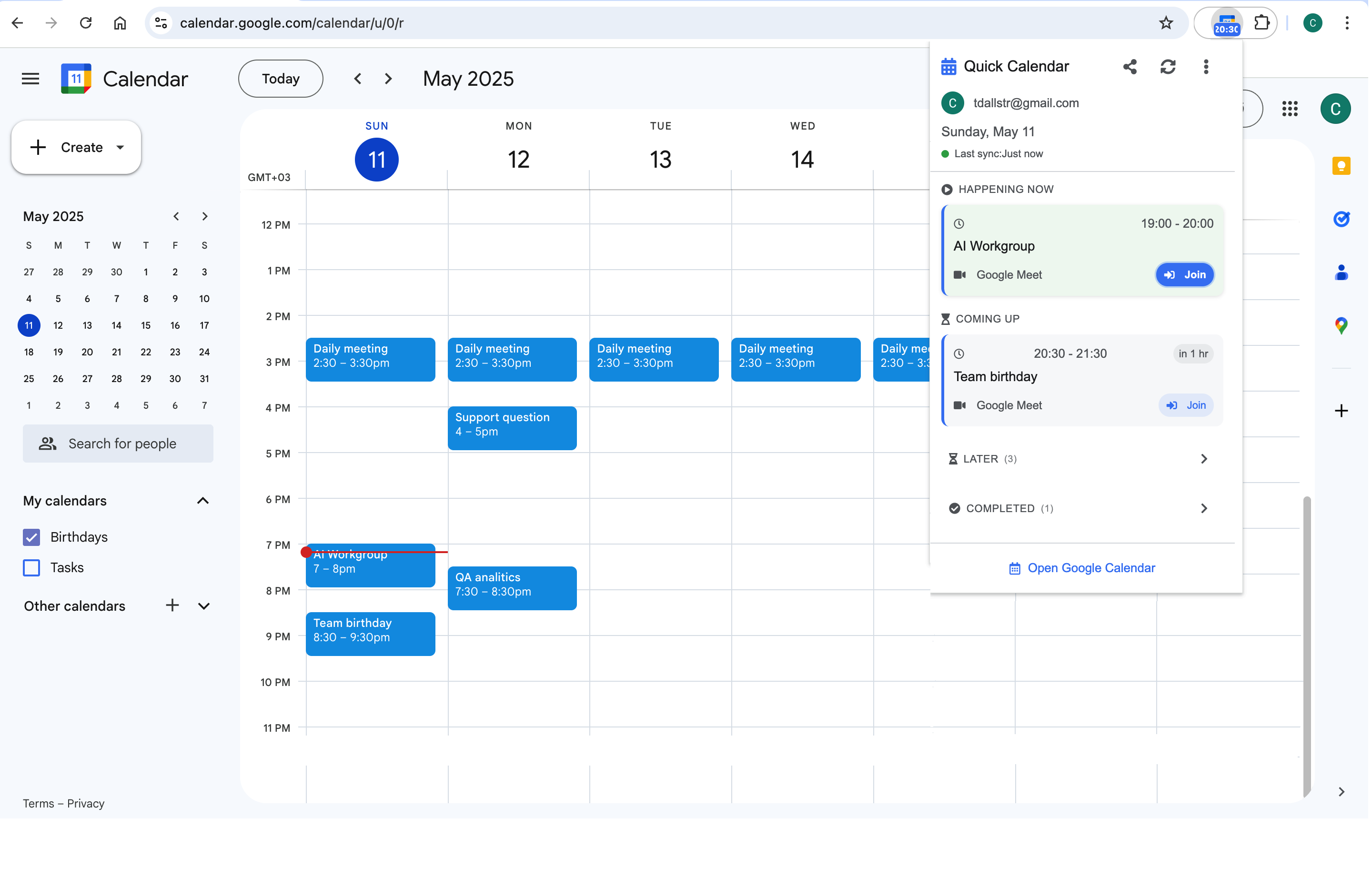
A list shows events; a timeline with a now-line shows the day’s shape — the gap you could use, the cluster you should brace for. Spacing is information that lists throw away.
3 · Time-to-event countdowns
"14:00" makes you do arithmetic; "in 23 min" is the arithmetic done. Chips like this are the difference between checking a fact and absorbing one.
4 · One-click meeting joins
The extension should parse Meet/Zoom/Teams links out of events and surface a join button. Measured honestly, this replaces the worst 40 seconds of every remote meeting: the hunt through the event → description → right link.
5 · Multi-calendar merge
Work, personal overlay, the team calendar — the popup must render your subscribed set in one strip, or it answers "what’s next" wrongly for everyone with more than one layer (which is everyone).
6 · Quick add for the small stuff
"Block 30 min at 15:00" should not require the full editor. Creation beyond that (guests, rooms, recurrence) rightly belongs to the big calendar — an extension that tries to replicate the full editor has misunderstood its job.
7 · A clean handoff to the full calendar
The popup ends where sessions begin: one obvious "Open Google Calendar" for everything bigger. Respecting its own boundary is a design smell in the good direction.
The five-minute test protocol
Install → check the permission prompt against red flag #1 → time the popup open (×3) → verify the three answers with your real calendar → tap a join button on today’s next meeting → find the privacy policy. Twenty minutes across two or three candidates settles what review-reading never does, because the core loop is felt, not described.
For calibration: this checklist is the spec Calendar Extension for Google Calendar™ is built against — timeline with now-line, time-to-event chips, join buttons, quick add, and the deliberate handoff at the bottom. Run the five-minute protocol on it and its alternatives alike; a tool confident in its core loop survives its own checklist.
Frequently asked questions
Directionally, with two filters: weight recent reviews (products change hands and models), and read the 2–3 star ones specifically — they describe real trade-offs where 5s cheer and 1s rage. Pair with the developer’s response pattern: maintained products answer.
From the outside: the privacy policy states it (or damns by omission), and the permission set hints — a display extension needing "communicate with external sites" beyond Google’s APIs deserves the question. When in doubt, ask the developer directly; maintained products answer that too.
They serve the same glance layer on different surfaces — pick where your attention lives. Browser-dwellers get more from the toolbar (no app switch mid-tab); native-app people get more from the menu bar. Running both is redundancy without harm, but one usually atrophies.
A different genus (page-enhancers vs. glance surfaces) with a different risk profile: they inject code into the calendar page, so scope and maintenance matter double — Google’s UI changes break them regularly. Judge them by update cadence; an unmaintained page-enhancer is a future Tuesday outage.