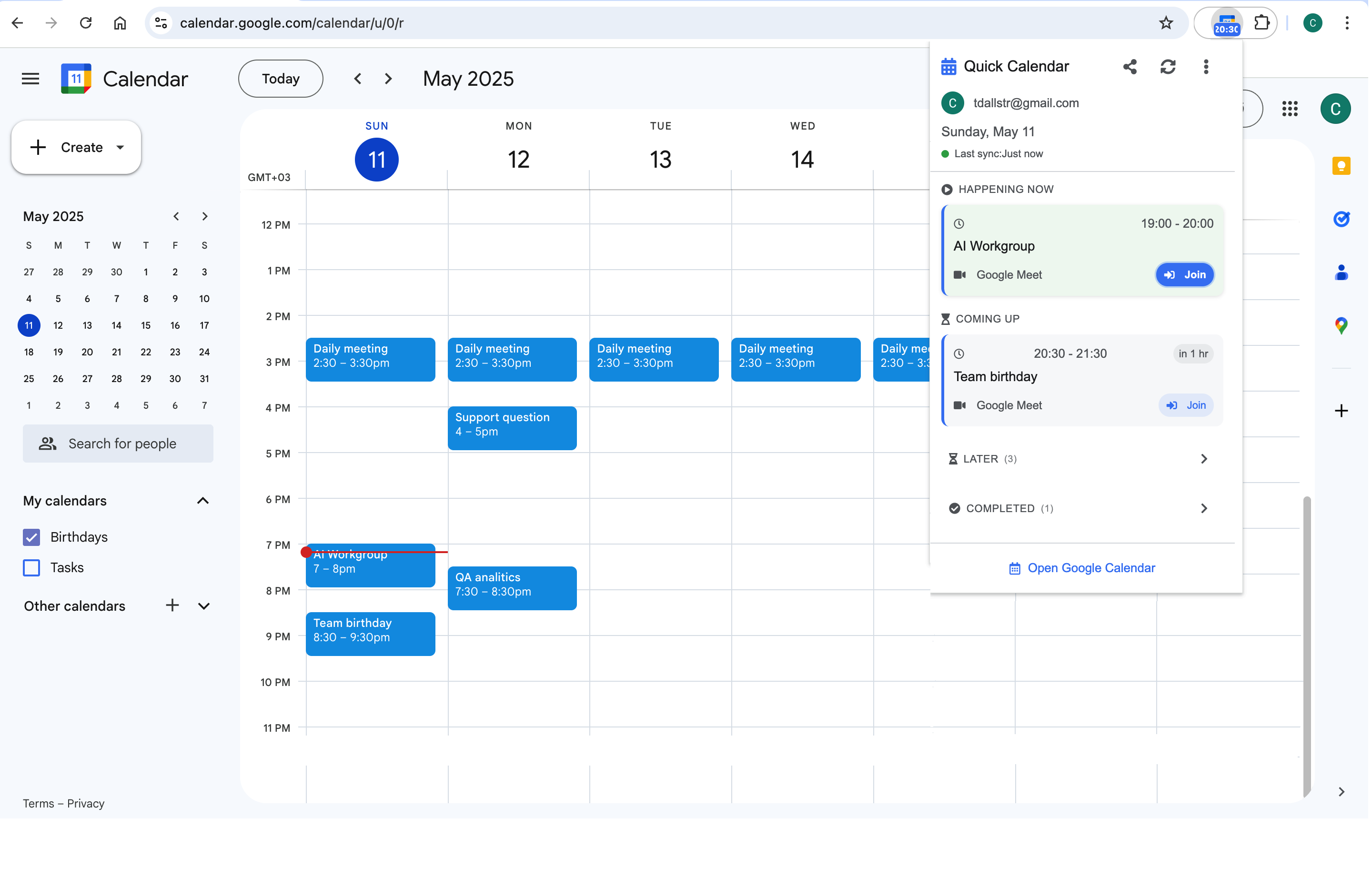
Species 1 · Toolbar glance surfaces
What: popup day-views over your existing Google Calendar — timeline, countdown chips, join buttons, quick add. Job: the 20–40 daily checks and the meeting-join transition. Risk profile: lowest of the field when read-scoped — no second database, nothing to sync. Who needs one: anyone whose work lives in a browser; it is the default first tool of the browser-first stack. Calendar Extension for Google Calendar™ is this species: the popup answers what’s-next/when/how-long and hands off to the full calendar for sessions — the species’ defining division of labor.
Species 2 · Page enhancers
What: extensions that inject features into calendar.google.com — extra buttons, layout tweaks, bulk operations. Job: upgrading the session surface itself. Risk profile: the field’s highest maintenance exposure — they ride Google’s DOM, and every Calendar UI update is a potential Tuesday outage; scope requests also run broader by necessity. Who needs one: power schedulers with a specific missing feature. Judge candidates by update cadence above all — an unmaintained enhancer is a countdown, not a tool.
Species 3 · New-tab and dashboard calendars
What: your schedule rendered on every new tab (or a dashboard page) alongside tasks, weather, quotes. Job: passive ambient awareness. The honest trade: new-tab surfaces show the calendar when you weren’t asking — which is either gentle ambient reinforcement or forty daily micro-exposures to your meeting load, depending on your relationship with the schedule. People with calendar anxiety should pick the on-demand species instead; ambient exposure is a feature only when the feeling it ambiently produces is calm.
Species 4 · Web-app session clients
What: full alternative calendars in a tab (Notion Calendar’s web presence, and the scheduling super-apps). Job: replacing the session surface with better ergonomics or integrations. Risk profile: the migration question — tools that only render your Google data uninstall cleanly; tools that ingest it into their own backend hold your workflows hostage at pivot time. The species question to ask before adopting: "window or warehouse?"
The standards, regardless of species
Five bars any 2026 browser calendar tool should clear: permission-scope honesty (the prompt reads like the feature list), a findable privacy policy stating where events are processed, sub-second interaction (glance tools especially — slow defeats the species), graceful Google-outage behavior (fails visible, not weird), and a clean exit (uninstall leaves your calendar exactly as found). The field has matured enough that failing any bar means a better neighbor exists.
Building the stack
Most browser-first setups need exactly two pieces: the Google Calendar web app for sessions, and a Species-1 glance surface for everything else. Add a Species-2 enhancer only for a named missing feature; add Species-4 only if your team’s truth already lives in that ecosystem. The minimal stack is not a compromise — it is the configuration with the fewest silent failure modes, which in calendar tooling is the metric that ends up mattering.
Frequently asked questions
Subject to two gates: your Workspace admin’s third-party app policy (some orgs allowlist), and the tool’s own scope/processing answers. Read-only, locally-processing glance tools are the easiest case to clear with IT — bring the privacy policy to the conversation rather than asking abstractly.
Where offered, it is a legitimate minimal glance layer — test it first. Dedicated tools earn their install with the delta: richer timelines, countdown chips, join parsing across Zoom/Teams, quick add. If the built-in covers your three questions, the built-in wins; defaults deserve first refusal.
More than one per species is one too many — two glance surfaces answer the same question with double the permission surface. The full stack above is at most three tools total, and most people are correctly served by two.
Consolidation and standards: the surviving tools got faster (sub-second popups are now table stakes), privacy policies became findable as users started asking, and join-link parsing across conferencing vendors went from differentiator to baseline. The buying advice simplified accordingly: hold the five bars, pick per species.